Curl and Divergence β€” Question 9

PDF β†—

Question 9

On D=ℝ3\{𝟎}D=\mathbb R^3\setminus\{\mathbf 0\}, define 𝑭(x,y,z)=⟨x,y,z⟩(x2+y2+z2)3/2.\mathbf F(x,y,z)=\frac{\langle x,y,z\rangle}{(x^2+y^2+z^2)^{3/2}}.

Tasks

  1. Compute βˆ‡β‹…π‘­\nabla\cdot\mathbf F on DD.

  2. Compute or otherwise justify βˆ‡Γ—π‘­\nabla\times\mathbf F on DD.

  3. Explain why the excluded origin must be stated.
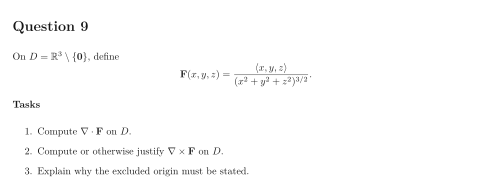
Original worksheet page 1: question and worked solution for 6-1-009
Show solutionHide solution

Question 9 – Solution

Strategy. Write r=(x2+y2+z2)1/2r=(x^2+y^2+z^2)^{1/2} and differentiate xrβˆ’3xr^{-3}, yrβˆ’3yr^{-3}, and zrβˆ’3zr^{-3}.

Step 1: Divergence Since βˆ‚βˆ‚x(xrβˆ’3)=rβˆ’3βˆ’3x2rβˆ’5,\frac{\partial}{\partial x}(xr^{-3})=r^{-3}-3x^2r^{-5}, with analogous formulas for yy and zz, βˆ‡β‹…π‘­=3rβˆ’3βˆ’3(x2+y2+z2)rβˆ’5=3rβˆ’3βˆ’3r2rβˆ’5=0,r>0.\begin{align*} \nabla\cdot\mathbf F &=3r^{-3}-3(x^2+y^2+z^2)r^{-5}\\ &=3r^{-3}-3r^2r^{-5}=\boxed{0},\qquad r>0. \end{align*}

See the diagram in the original worksheet below.

Step 2: Curl Because 𝑭=βˆ‡(βˆ’1r)\mathbf F=\nabla\!\left(-\frac 1r\right) on DD, the curl-of-a-gradient identity gives βˆ‡Γ—π‘­=𝟎.\boxed{\nabla\times\mathbf F=\mathbf 0}.

Step 3: Domain caveat The formula is undefined at the origin, and the derivatives used above do not exist there. The conclusions are pointwise statements on DD, not statements at 𝟎\mathbf 0.

Verification Direct cross differentiation gives, for example, Ryβˆ’Qz=βˆ’3yzrβˆ’5βˆ’(βˆ’3yzrβˆ’5)=0R_y-Q_z=-3yzr^{-5}-(-3yzr^{-5})=0, and the other two components cancel similarly.

Original worksheet page 2: question and worked solution for 6-1-009

Original worksheet layout. Use Enlarge or open the PDF for a closer view.