Surface Integrals of Vector Fields β€” Question 2

PDF β†—

Question 2

Let SS be the paraboloid patch z=x2+y2z=x^2+y^2 above x2+y2≀1x^2+y^2\le 1, oriented upward. For 𝑭(x,y,z)=⟨x,y,1⟩,\mathbf F(x,y,z)=\langle x,y,1\rangle, compute the flux across SS.

Tasks

  1. Derive the upward vector surface element.

  2. Evaluate the flux in polar coordinates.

  3. Explain how positive and negative contributions cancel.
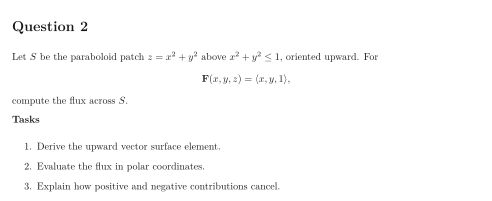
Original worksheet page 1: question and worked solution for 6-4-002
Show solutionHide solution

Question 2 – Solution

Strategy. Use the upward graph element βŸ¨βˆ’gx,βˆ’gy,1⟩dA\langle-g_x,-g_y,1\rangle dA and then exploit radial symmetry.

Step 1: Vector area element For g(x,y)=x2+y2g(x,y)=x^2+y^2, 𝒏dS=βŸ¨βˆ’2x,βˆ’2y,1⟩dA.\boxed{\mathbf n\,dS=\langle-2x,-2y,1\rangle\,dA}. Thus 𝑭⋅𝒏dS=(βˆ’2x2βˆ’2y2+1)dA=(1βˆ’2r2)dA.\mathbf F\cdot\mathbf n\,dS =(-2x^2-2y^2+1)\,dA=(1-2r^2)\,dA.

See the diagram in the original worksheet below.

Step 2: Integrate ∬S𝑭⋅𝒏dS=∫02Ο€βˆ«01(1βˆ’2r2)rdrdΞΈ=2Ο€[r22βˆ’r42]01=0.\begin{align*} \iint_S\mathbf F\cdot\mathbf n\,dS &=\int_0^{2\pi}\int_0^1(1-2r^2)r\,dr\,d\theta\\ &=2\pi\left[\frac{r^2}{2}-\frac{r^4}{2}\right]_0^1 =\boxed{0}. \end{align*}

Step 3: Locate the cancellation The normal component is positive for r<1/2r<1/\sqrt 2 and negative for r>1/2r>1/\sqrt 2. The inner contribution is 2Ο€[r22βˆ’r42]01/2=Ο€4,2\pi\left[\frac{r^2}{2}-\frac{r^4}{2}\right]_0^{1/\sqrt 2}=\frac\pi 4, while the outer annulus contributes βˆ’Ο€/4-\pi/4.

Verification The exact cancellation explains why zero flux does not mean the field is tangent everywhere.
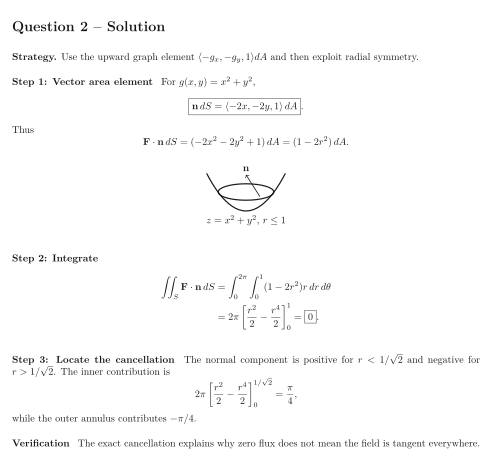
Original worksheet page 2: question and worked solution for 6-4-002

Original worksheet layout. Use Enlarge or open the PDF for a closer view.