Surface Integrals of Vector Fields — Question 4

PDF ↗

Question 4

For a>0a>0, let SaS_a be the sphere x2+y2+z2=a2x^2+y^2+z^2=a^2, oriented outward. Consider the inverse-square radial field 𝑭(x,y,z)=⟨x,y,z⟩(x2+y2+z2)3/2.\mathbf F(x,y,z)=\frac{\langle x,y,z\rangle}{(x^2+y^2+z^2)^{3/2}}.

Tasks

  1. Find 𝑭⋅𝒏\mathbf F\cdot\mathbf n on SaS_a.

  2. Compute the outward flux directly.

  3. Explain why the result is independent of aa.

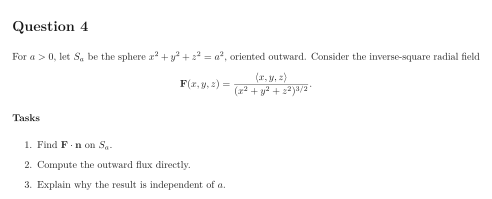
Original worksheet page 1: question and worked solution for 6-4-004
Show solutionHide solution

Question 4 – Solution

Strategy. On a centered sphere, the field and unit normal are parallel; only their magnitudes need to be compared.

Step 1: Normal component Write 𝒙=⟨x,y,z⟩\mathbf x=\langle x,y,z\rangle. On SaS_a, 𝒏=𝒙a,𝑭=𝒙a3.\mathbf n=\frac{\mathbf x}{a},\qquad \mathbf F=\frac{\mathbf x}{a^3}. Consequently, 𝑭⋅𝒏=𝒙⋅𝒙a4=1a2.\boxed{\mathbf F\cdot\mathbf n =\frac{\mathbf x\cdot\mathbf x}{a^4}=\frac 1{a^2}}.

See the diagram in the original worksheet below.

Step 2: Integrate Since the sphere has area 4πa24\pi a^2, ∬Sa𝑭⋅𝒏dS=1a2(4πa2)=4π.\boxed{\iint_{S_a}\mathbf F\cdot\mathbf n\,dS =\frac 1{a^2}(4\pi a^2)=4\pi}.

Step 3: Interpret the scale Increasing the radius weakens the normal component by the factor a−2a^{-2} while increasing spherical area by a2a^2. These factors cancel exactly.

Verification The field is everywhere outward on SaS_a, so the positive sign is correct. The calculation is direct and uses no theorem about closed surfaces.
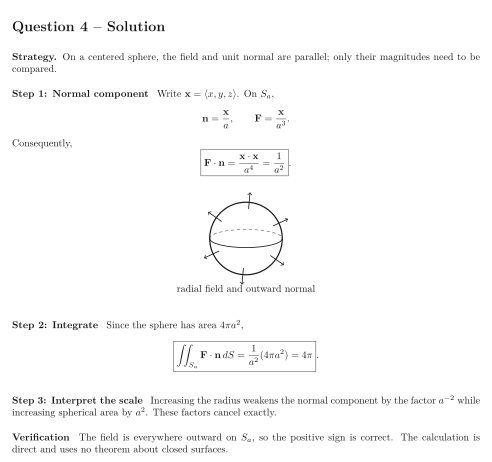
Original worksheet page 2: question and worked solution for 6-4-004

Original worksheet layout. Use Enlarge or open the PDF for a closer view.