Question 7
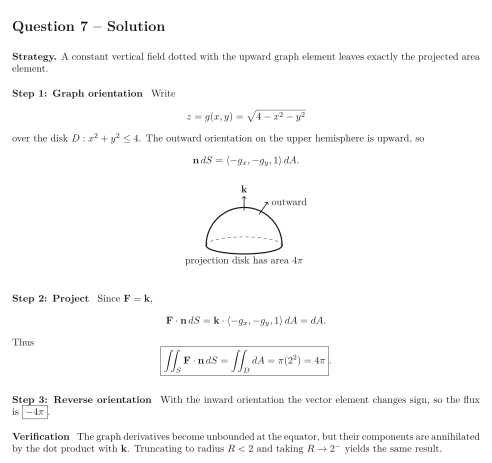
Let be the upper hemisphere , , oriented outward. Compute the flux of the constant field across .
Tasks
Express the hemisphere as a graph and find its upward vector element.
Evaluate the flux using projection onto the -plane.
State the result for the opposite orientation.
Show solutionHide solution
Question 7 – Solution
Strategy. A constant vertical field dotted with the upward graph element leaves exactly the projected area element.
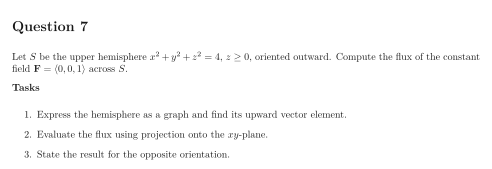
Step 1: Graph orientation Write over the disk . The outward orientation on the upper hemisphere is upward, so
See the diagram in the original worksheet below.
Step 2: Project Since , Thus
Step 3: Reverse orientation With the inward orientation the vector element changes sign, so the flux is .
Verification The graph derivatives become unbounded at the equator, but their components are annihilated by the dot product with . Truncating to radius and taking yields the same result.