Question 2
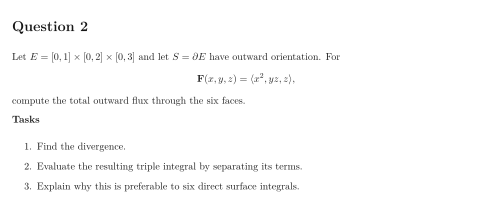
Let and let have outward orientation. For compute the total outward flux through the six faces.
Tasks
Find the divergence.
Evaluate the resulting triple integral by separating its terms.
Explain why this is preferable to six direct surface integrals.
Show solutionHide solution
Question 2 – Solution
Strategy. The box is closed and the field is smooth, so one volume integral replaces six oriented face calculations.
Step 1: Divergence
See the diagram in the original worksheet below.
Step 2: Integrate term by term The three contributions over are Hence
Step 3: Interpret A direct method would require a different outward normal and parameter domain on every face. The divergence automatically combines all six signed contributions.
Verification The divergence is positive throughout , so a positive net outward flux is consistent.
