Question 4
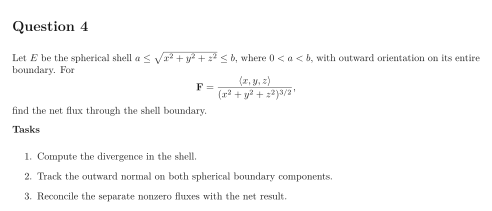
Let be the spherical shell , where , with outward orientation on its entire boundary. For find the net flux through the shell boundary.
Tasks
Compute the divergence in the shell.
Track the outward normal on both spherical boundary components.
Reconcile the separate nonzero fluxes with the net result.
Show solutionHide solution
Question 4 – Solution
Strategy. The origin is excluded from the shell, so the field is smooth there and has zero divergence; the inner normal points toward the origin.
Step 1: Apply the theorem For , Therefore
See the diagram in the original worksheet below.
Step 2: Outer sphere At , points in the outward-normal direction with normal component . Hence
Step 3: Inner sphere The outward normal for the shell at points into the cavity, namely . Thus The two boundary components sum to zero.
Verification The cancellation depends on reversing the normal at the inner boundary; using the radial normal on both spheres would not describe the shell’s outward orientation.
