Question 6
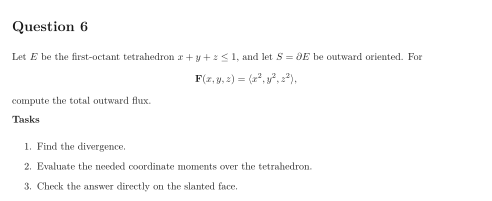
Let be the first-octant tetrahedron , and let be outward oriented. For compute the total outward flux.
Tasks
Find the divergence.
Evaluate the needed coordinate moments over the tetrahedron.
Check the answer directly on the slanted face.
Show solutionHide solution
Question 6 – Solution
Strategy. Symmetry makes the three first moments equal; the coordinate-plane faces also provide a short direct check.
Step 1: Divergence The tetrahedron has volume and centroid , so
See the diagram in the original worksheet below.
Step 2: Apply the theorem
Step 3: Direct check On each coordinate face the corresponding field component is zero, so those fluxes vanish. On , the outward vector element is , giving
Verification The direct slanted-face integral agrees with the divergence result and is positive, as expected in the first octant.
