Question 10
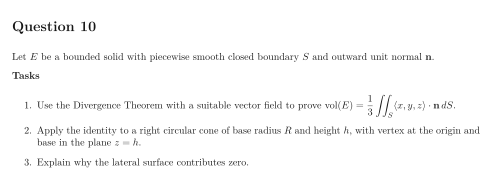
Let be a bounded solid with piecewise smooth closed boundary and outward unit normal .
Tasks
Use the Divergence Theorem with a suitable vector field to prove .
Apply the identity to a right circular cone of base radius and height , with vertex at the origin and base in the plane .
Explain why the lateral surface contributes zero.
Show solutionHide solution
Question 10 – Solution
Strategy. Choose a field with divergence , then exploit the fact that the cone’s radial position vector is tangent to its lateral generators.
Step 1: Derive the identity Let Then , so
See the diagram in the original worksheet below.
Step 2: Lateral surface Every ray from the origin along the cone is tangent to the lateral surface. Hence is tangent there and
Step 3: Base On the base, and , so the dot product equals . Therefore
Verification The formula has the expected “one-third base times height” form and correct cubic units.
