Question 2
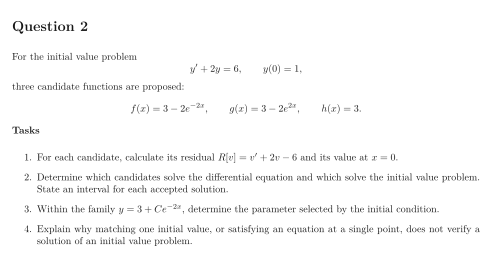
For the initial value problem three candidate functions are proposed: Tasks
For each candidate, calculate its residual and its value at .
Determine which candidates solve the differential equation and which solve the initial value problem. State an interval for each accepted solution.
Within the family , determine the parameter selected by the initial condition.
Explain why matching one initial value, or satisfying an equation at a single point, does not verify a solution of an initial value problem.
Show solutionHide solution
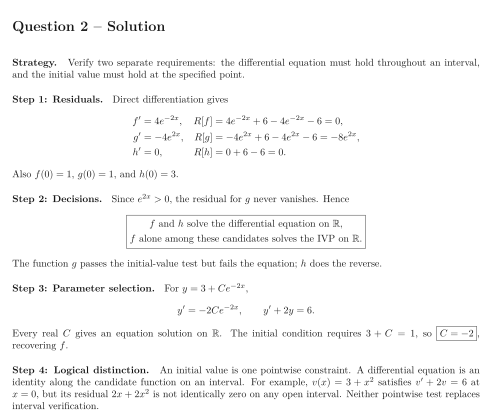
Question 2 – Solution
Strategy. Verify two separate requirements: the differential equation must hold throughout an interval, and the initial value must hold at the specified point.
Step 1: Residuals. Direct differentiation gives Also , , and .
Step 2: Decisions. Since , the residual for never vanishes. Hence The function passes the initial-value test but fails the equation; does the reverse.
Step 3: Parameter selection. For , Every real gives an equation solution on . The initial condition requires , so , recovering .
Step 4: Logical distinction. An initial value is one pointwise constraint. A differential equation is an identity along the candidate function on an interval. For example, satisfies at , but its residual is not identically zero on any open interval. Neither pointwise test replaces interval verification.