Question 5
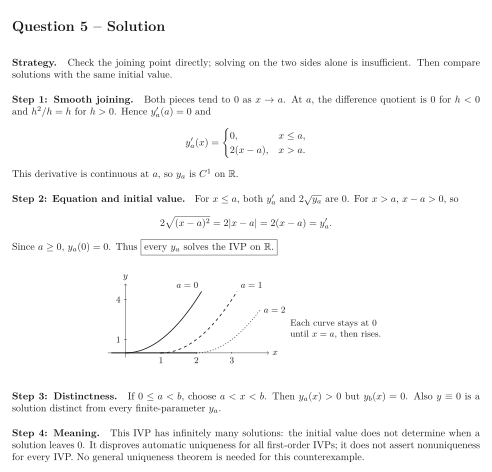
Consider the initial value problem where the square root is the nonnegative real root. For each real parameter , define on Tasks
Prove that is continuously differentiable at its joining point .
Verify the differential equation everywhere, including at , and verify the initial value.
Show that different parameters give distinct solutions of the same IVP. Identify an additional solution that never leaves .
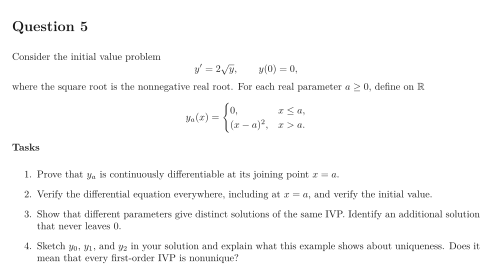
Sketch , , and in your solution and explain what this example shows about uniqueness. Does it mean that every first-order IVP is nonunique?
Show solutionHide solution
Question 5 – Solution
Strategy. Check the joining point directly; solving on the two sides alone is insufficient. Then compare solutions with the same initial value.
Step 1: Smooth joining. Both pieces tend to as . At , the difference quotient is for and for . Hence and This derivative is continuous at , so is on .
Step 2: Equation and initial value. For , both and are . For , , so Since , . Thus
See the diagram in the original worksheet below.
Step 3: Distinctness. If , choose . Then but . Also is a solution distinct from every finite-parameter .
Step 4: Meaning. This IVP has infinitely many solutions: the initial value does not determine when a solution leaves . It disproves automatic uniqueness for all first-order IVPs; it does not assert nonuniqueness for every IVP. No general uniqueness theorem is needed for this counterexample.