Question 9
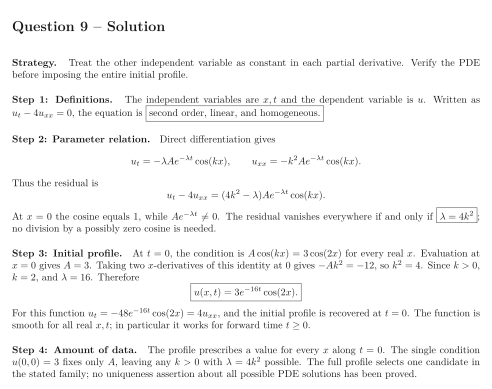
For a function , consider the partial differential equation and initial profile Search only within the candidate family where , , and are real constants.
Tasks
State the independent and dependent variables, the order of the PDE, and whether it is linear and homogeneous.
Calculate and and determine exactly which relation among the parameters makes the family satisfy the PDE everywhere.
Use the initial profile to determine , , and , and verify the resulting function.
Explain why a condition specifying supplies more information than one scalar condition such as . Distinguish uniqueness within the proposed family from uniqueness among all PDE solutions.
Show solutionHide solution
Question 9 – Solution
Strategy. Treat the other independent variable as constant in each partial derivative. Verify the PDE before imposing the entire initial profile.
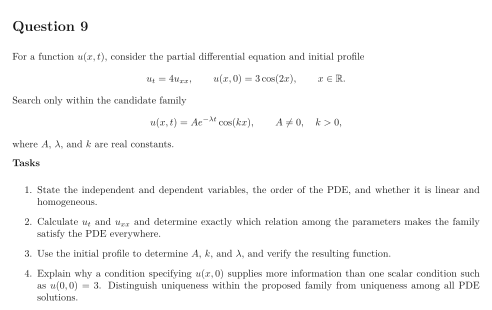
Step 1: Definitions. The independent variables are and the dependent variable is . Written as , the equation is
Step 2: Parameter relation. Direct differentiation gives Thus the residual is At the cosine equals , while . The residual vanishes everywhere if and only if ; no division by a possibly zero cosine is needed.
Step 3: Initial profile. At , the condition is for every real . Evaluation at gives . Taking two -derivatives of this identity at gives , so . Since , , and . Therefore For this function , and the initial profile is recovered at . The function is smooth for all real ; in particular it works for forward time .
Step 4: Amount of data. The profile prescribes a value for every along . The single condition fixes only , leaving any with possible. The full profile selects one candidate in the stated family; no uniqueness assertion about all possible PDE solutions has been proved.