Question 4
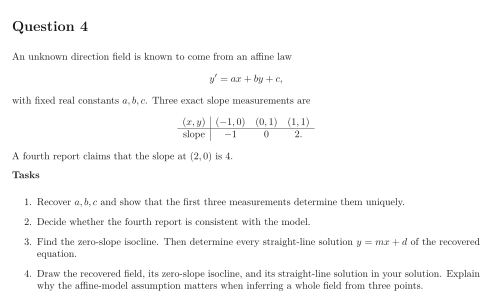
An unknown direction field is known to come from an affine law with fixed real constants . Three exact slope measurements are A fourth report claims that the slope at is .
Tasks
Recover and show that the first three measurements determine them uniquely.
Decide whether the fourth report is consistent with the model.
Find the zero-slope isocline. Then determine every straight-line solution of the recovered equation.
Draw the recovered field, its zero-slope isocline, and its straight-line solution in your solution. Explain why the affine-model assumption matters when inferring a whole field from three points.
Show solutionHide solution
Question 4 – Solution
Strategy. Recover the coefficients from independent data, then compare the geometric slope of a line with the field along it.
Step 1: Recover the law. The measurements give Subtracting the second equation from the third gives . The first then gives , and the second gives . These forced values prove uniqueness within the affine class: At the predicted slope is , so the reported value is inconsistent.
See the diagram in the original worksheet below.
Step 2: Reference line and solution line. Zero slopes occur on , which is not a solution: its derivative is , not . Substituting into the equation requires for every in an interval. Hence and . The only straight-line solution is , verified by .
Step 3: Limits of inference. Three data points determine the three affine coefficients here. Without the affine assumption, many nonlinear functions could agree at those points while assigning different slopes elsewhere. Finite measurements alone do not determine an unrestricted field.
