Question 1
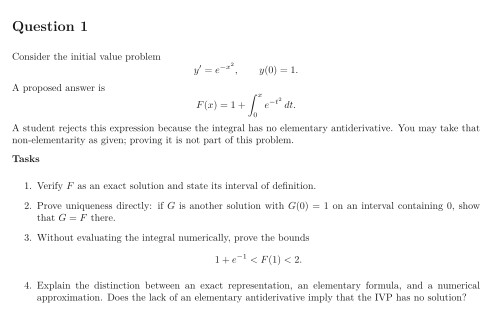
Consider the initial value problem A proposed answer is A student rejects this expression because the integral has no elementary antiderivative. You may take that non-elementarity as given; proving it is not part of this problem.
Tasks
Verify as an exact solution and state its interval of definition.
Prove uniqueness directly: if is another solution with on an interval containing , show that there.
Without evaluating the integral numerically, prove the bounds
Explain the distinction between an exact representation, an elementary formula, and a numerical approximation. Does the lack of an elementary antiderivative imply that the IVP has no solution?
Show solutionHide solution
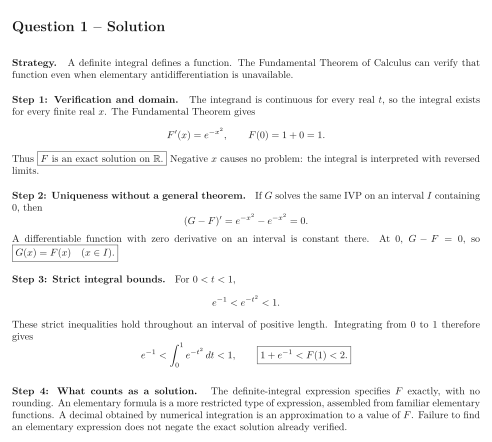
Question 1 – Solution
Strategy. A definite integral defines a function. The Fundamental Theorem of Calculus can verify that function even when elementary antidifferentiation is unavailable.
Step 1: Verification and domain. The integrand is continuous for every real , so the integral exists for every finite real . The Fundamental Theorem gives Thus Negative causes no problem: the integral is interpreted with reversed limits.
Step 2: Uniqueness without a general theorem. If solves the same IVP on an interval containing , then A differentiable function with zero derivative on an interval is constant there. At , , so
Step 3: Strict integral bounds. For , These strict inequalities hold throughout an interval of positive length. Integrating from to therefore gives
Step 4: What counts as a solution. The definite-integral expression specifies exactly, with no rounding. An elementary formula is a more restricted type of expression, assembled from familiar elementary functions. A decimal obtained by numerical integration is an approximation to a value of . Failure to find an elementary expression does not negate the exact solution already verified.