Question 5
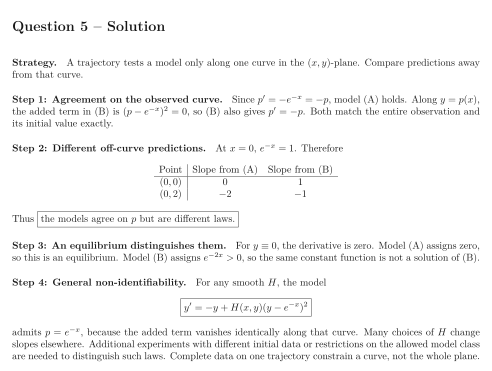
An experiment records the complete trajectory for all , with . Two proposed models are Tasks
Verify that the recorded trajectory satisfies both models.
Compare the slopes predicted by the models at and . Are the right-hand sides the same function of ?
Test whether is an equilibrium solution of each model.
Explain why even a complete, noiseless trajectory does not identify an unrestricted differential equation uniquely. Generalize the construction by replacing the added square with a term involving an arbitrary smooth function .
Show solutionHide solution
Question 5 – Solution
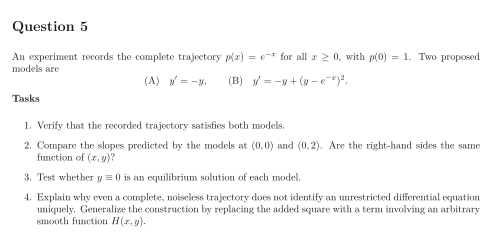
Strategy. A trajectory tests a model only along one curve in the -plane. Compare predictions away from that curve.
Step 1: Agreement on the observed curve. Since , model (A) holds. Along , the added term in (B) is , so (B) also gives . Both match the entire observation and its initial value exactly.
Step 2: Different off-curve predictions. At , . Therefore Thus
Step 3: An equilibrium distinguishes them. For , the derivative is zero. Model (A) assigns zero, so this is an equilibrium. Model (B) assigns , so the same constant function is not a solution of (B).
Step 4: General non-identifiability. For any smooth , the model admits , because the added term vanishes identically along that curve. Many choices of change slopes elsewhere. Additional experiments with different initial data or restrictions on the allowed model class are needed to distinguish such laws. Complete data on one trajectory constrain a curve, not the whole plane.