Question 2
On the domain , consider Tasks
Solve the IVP using an integrating factor, showing the integration-by-parts step needed for the forcing term.
State the largest open interval containing on which the solution solves this equation, and verify the initial value and differential equation.
Rewrite the solution using a definite integral based at . Use the sign of that integral to decide whether the solution can be negative.
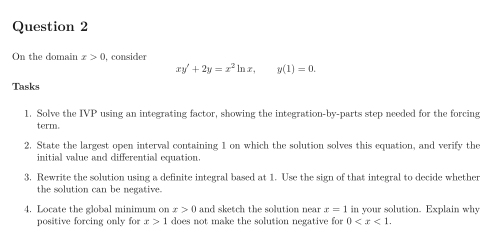
Locate the global minimum on and sketch the solution near in your solution. Explain why positive forcing only for does not make the solution negative for .
Show solutionHide solution
Question 2 – Solution
Strategy. Use as integrating factor, then retain a definite-integral form to analyze signs on both sides of the initial point.
Step 1: Solve. Dividing by gives . With , Integration by parts, , , yields The initial value forces , hence
See the diagram in the original worksheet below.
Step 2: Verify. Substitution at gives zero. Differentiating gives , or ; division by recovers the original equation. The logarithm and coefficient division restrict the interval to .
Step 3: Sign and minimum. Equivalently, For the integral is positive. For , the integrand is negative between and , but the reversed limits make the integral positive. Since , for . Thus . The sign of the forcing alone does not determine the sign of the solution.