Question 10
Let be a real parameter in Tasks
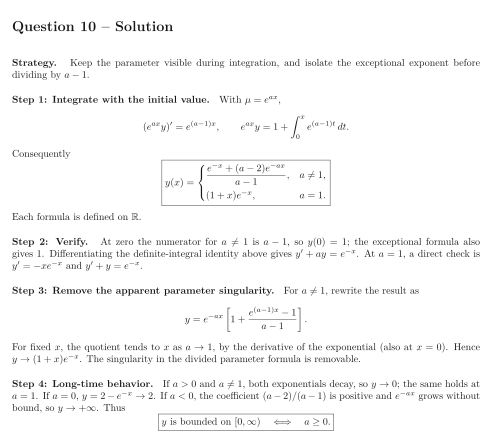
Solve the IVP for every real , handling separately any parameter value for which the usual antiderivative formula changes.
Verify the initial condition and equation, and state the solution interval for each parameter.
For fixed , show that the formula for tends to the solution as . Explain why an apparent denominator singularity in a parameter need not be a singularity of the solution.
Determine exactly which values of produce a bounded solution on , and compute the limit or divergence as in each parameter range.
Show solutionHide solution
Question 10 – Solution
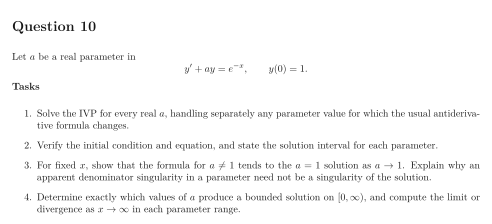
Strategy. Keep the parameter visible during integration, and isolate the exceptional exponent before dividing by .
Step 1: Integrate with the initial value. With , Consequently Each formula is defined on .
Step 2: Verify. At zero the numerator for is , so ; the exceptional formula also gives . Differentiating the definite-integral identity above gives . At , a direct check is and .
Step 3: Remove the apparent parameter singularity. For , rewrite the result as For fixed , the quotient tends to as , by the derivative of the exponential (also at ). Hence . The singularity in the divided parameter formula is removable.
Step 4: Long-time behavior. If and , both exponentials decay, so ; the same holds at . If , . If , the coefficient is positive and grows without bound, so . Thus