Question 2
For the autonomous equation consider the initial condition .
Tasks
Find every constant solution before dividing by any expression involving .
Obtain the nonconstant solution family by separation and solve the given initial-value problem.
Find its maximal interval containing , its direction of motion, and its limiting values at the ends of that interval.
Find the exact positive time when . Explain why this solution never reaches or crosses at a finite time.
Show solutionHide solution
Question 2 – Solution
Strategy. Preserve the two equilibrium solutions, then use partial fractions on a nonconstant branch.
Step 1: Separate without losing constants. The constant solutions are . Away from those values, The nonconstant family can be written , , on intervals where the denominator is nonzero. The value restores ; must still be listed separately.
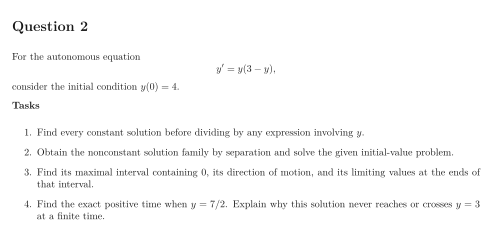
Step 2: Apply the data and determine the domain. From , , so Here , so . The limits are at the left endpoint and as . Writing gives , verifying the equation.
Step 3: Compute the passage time. The equation gives . At any finite , the exponential is positive, so : the limiting level is never attained or crossed.
See the diagram in the original worksheet below.