Question 5
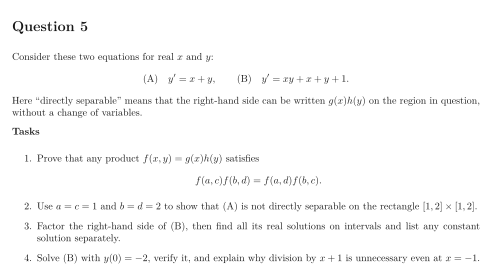
Consider these two equations for real and : Here “directly separable” means that the right-hand side can be written on the region in question, without a change of variables.
Tasks
Prove that any product satisfies
Use and to show that (A) is not directly separable on the rectangle .
Factor the right-hand side of (B), then find all its real solutions on intervals and list any constant solution separately.
Solve (B) with , verify it, and explain why division by is unnecessary even at .
Show solutionHide solution
Question 5 – Solution
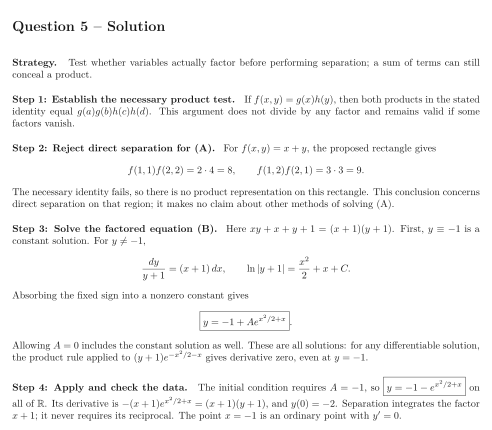
Strategy. Test whether variables actually factor before performing separation; a sum of terms can still conceal a product.
Step 1: Establish the necessary product test. If , then both products in the stated identity equal . This argument does not divide by any factor and remains valid if some factors vanish.
Step 2: Reject direct separation for (A). For , the proposed rectangle gives The necessary identity fails, so there is no product representation on this rectangle. This conclusion concerns direct separation on that region; it makes no claim about other methods of solving (A).
Step 3: Solve the factored equation (B). Here . First, is a constant solution. For , Absorbing the fixed sign into a nonzero constant gives Allowing includes the constant solution as well. These are all solutions: for any differentiable solution, the product rule applied to gives derivative zero, even at .
Step 4: Apply and check the data. The initial condition requires , so on all of . Its derivative is , and . Separation integrates the factor ; it never requires its reciprocal. The point is an ordinary point with .