Question 7
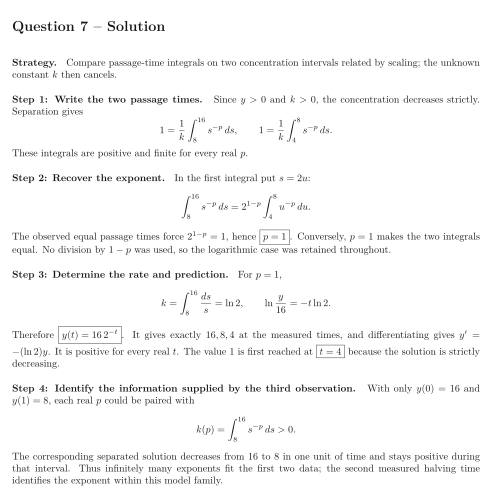
A positive concentration obeys a power-law decay model Use fixed units for time and concentration. Exact observations are Assume one pair of constants describes the entire observation interval.
Tasks
Express each of the two observed one-unit decay times as a separated definite integral, without assuming .
Prove that these observations determine uniquely. Treat the case without dividing by .
Find and the resulting solution, and predict when the concentration first reaches .
Explain why the first two observations alone would not determine .
Show solutionHide solution
Question 7 – Solution
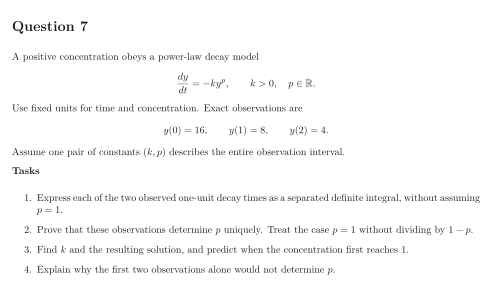
Strategy. Compare passage-time integrals on two concentration intervals related by scaling; the unknown constant then cancels.
Step 1: Write the two passage times. Since and , the concentration decreases strictly. Separation gives These integrals are positive and finite for every real .
Step 2: Recover the exponent. In the first integral put : The observed equal passage times force , hence . Conversely, makes the two integrals equal. No division by was used, so the logarithmic case was retained throughout.
Step 3: Determine the rate and prediction. For , Therefore . It gives exactly at the measured times, and differentiating gives . It is positive for every real . The value is first reached at because the solution is strictly decreasing.
Step 4: Identify the information supplied by the third observation. With only and , each real could be paired with The corresponding separated solution decreases from to in one unit of time and stays positive during that interval. Thus infinitely many exponents fit the first two data; the second measured halving time identifies the exponent within this model family.