Question 4
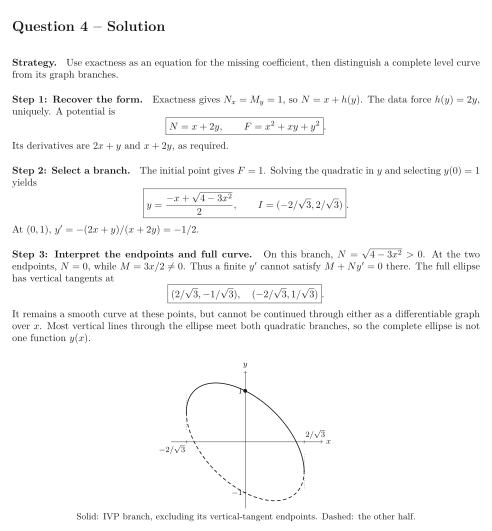
The coefficient is unknown in Assume is continuously differentiable on , the form is exact there, and the calibration data are for every real .
Tasks
Recover uniquely and construct a potential.
Select the solution through and find an explicit formula for its graph near that point.
Determine the maximal open interval of this graph and its slope at .
Find the vertical-tangent points of the full selected level curve. Explain why the full curve is not a single differentiable function .
Show solutionHide solution
Question 4 – Solution
Strategy. Use exactness as an equation for the missing coefficient, then distinguish a complete level curve from its graph branches.
Step 1: Recover the form. Exactness gives , so . The data force , uniquely. A potential is Its derivatives are and , as required.
Step 2: Select a branch. The initial point gives . Solving the quadratic in and selecting yields At , .
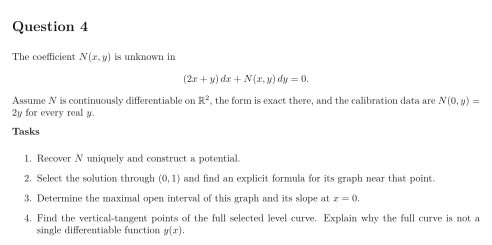
Step 3: Interpret the endpoints and full curve. On this branch, . At the two endpoints, , while . Thus a finite cannot satisfy there. The full ellipse has vertical tangents at It remains a smooth curve at these points, but cannot be continued through either as a differentiable graph over . Most vertical lines through the ellipse meet both quadratic branches, so the complete ellipse is not one function .
See the diagram in the original worksheet below.