Question 2
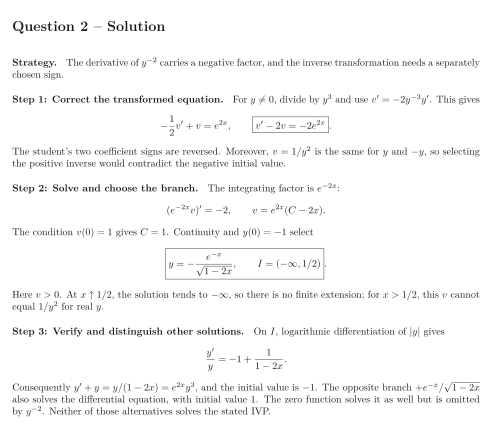
For the IVP a student sets but writes and then plans to use .
Tasks
Find both errors in this procedure and derive the correct equation for .
Solve the linear equation and select the original solution using the initial condition.
Find its maximal interval containing , explaining why a positive transformed variable does not determine the sign of .
Verify the original IVP, and state whether the opposite sign and the zero function solve the same differential equation.
Show solutionHide solution
Question 2 – Solution
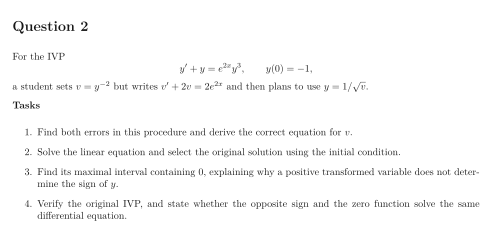
Strategy. The derivative of carries a negative factor, and the inverse transformation needs a separately chosen sign.
Step 1: Correct the transformed equation. For , divide by and use . This gives The student’s two coefficient signs are reversed. Moreover, is the same for and , so selecting the positive inverse would contradict the negative initial value.
Step 2: Solve and choose the branch. The integrating factor is : The condition gives . Continuity and select Here . At , the solution tends to , so there is no finite extension; for , this cannot equal for real .
Step 3: Verify and distinguish other solutions. On , logarithmic differentiation of gives Consequently , and the initial value is . The opposite branch also solves the differential equation, with initial value . The zero function solves it as well but is omitted by . Neither of those alternatives solves the stated IVP.