Question 8
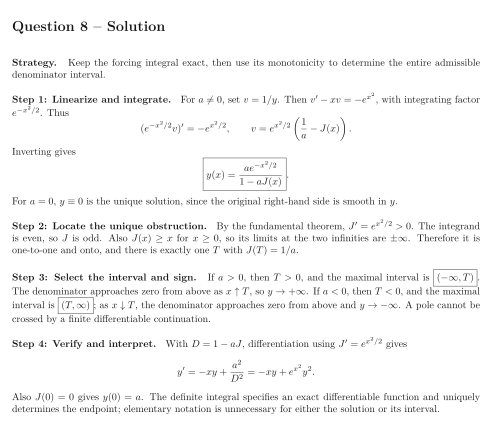
Consider Define ; an elementary antiderivative is not required.
Tasks
Solve the IVP for by the Bernoulli substitution, expressing the answer in terms of . Treat separately.
Prove that is strictly increasing onto and that the equation has exactly one real solution.
Determine the maximal interval containing for each sign of , and the sign of the divergence at its finite endpoint.
Verify the formula using the fundamental theorem of calculus and explain why an exact definite-integral expression is a complete answer.
Show solutionHide solution
Question 8 – Solution
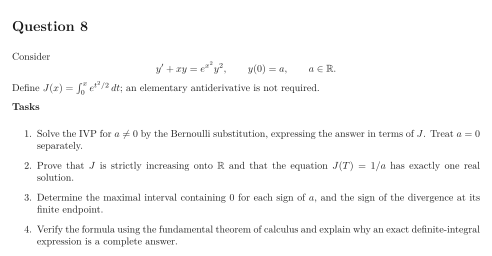
Strategy. Keep the forcing integral exact, then use its monotonicity to determine the entire admissible denominator interval.
Step 1: Linearize and integrate. For , set . Then , with integrating factor . Thus Inverting gives For , is the unique solution, since the original right-hand side is smooth in .
Step 2: Locate the unique obstruction. By the fundamental theorem, . The integrand is even, so is odd. Also for , so its limits at the two infinities are . Therefore it is one-to-one and onto, and there is exactly one with .
Step 3: Select the interval and sign. If , then , and the maximal interval is . The denominator approaches zero from above as , so . If , then , and the maximal interval is ; as , the denominator approaches zero from above and . A pole cannot be crossed by a finite differentiable continuation.
Step 4: Verify and interpret. With , differentiation using gives Also gives . The definite integral specifies an exact differentiable function and uniquely determines the endpoint; elementary notation is unnecessary for either the solution or its interval.