Question 10
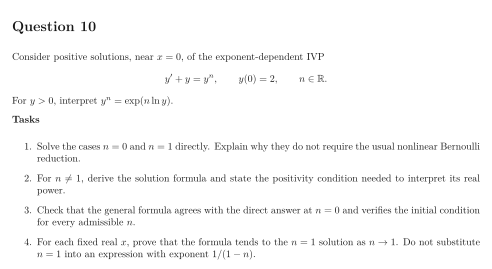
Consider positive solutions, near , of the exponent-dependent IVP For , interpret .
Tasks
Solve the cases and directly. Explain why they do not require the usual nonlinear Bernoulli reduction.
For , derive the solution formula and state the positivity condition needed to interpret its real power.
Check that the general formula agrees with the direct answer at and verifies the initial condition for every admissible .
For each fixed real , prove that the formula tends to the solution as . Do not substitute into an expression with exponent .
Show solutionHide solution
Question 10 – Solution
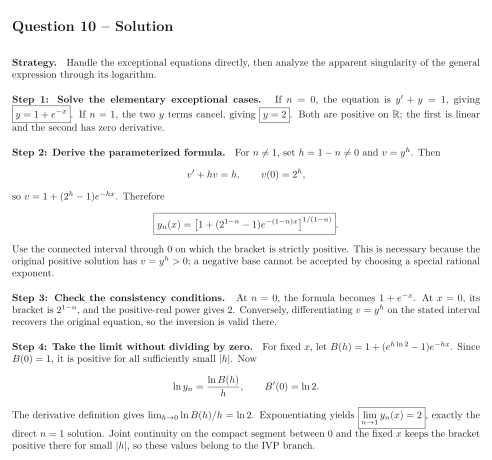
Strategy. Handle the exceptional equations directly, then analyze the apparent singularity of the general expression through its logarithm.
Step 1: Solve the elementary exceptional cases. If , the equation is , giving . If , the two terms cancel, giving . Both are positive on ; the first is linear and the second has zero derivative.
Step 2: Derive the parameterized formula. For , set and . Then so . Therefore Use the connected interval through on which the bracket is strictly positive. This is necessary because the original positive solution has ; a negative base cannot be accepted by choosing a special rational exponent.
Step 3: Check the consistency conditions. At , the formula becomes . At , its bracket is , and the positive-real power gives . Conversely, differentiating on the stated interval recovers the original equation, so the inversion is valid there.
Step 4: Take the limit without dividing by zero. For fixed , let . Since , it is positive for all sufficiently small . Now The derivative definition gives . Exponentiating yields , exactly the direct solution. Joint continuity on the compact segment between and the fixed keeps the bracket positive there for small , so these values belong to the IVP branch.