Question 7
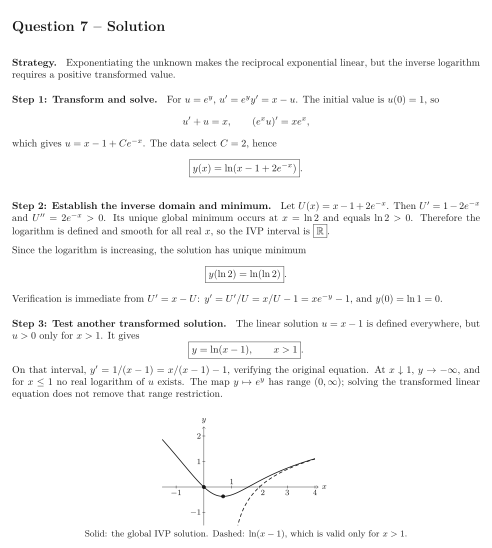
Consider
Tasks
Set and derive a linear differential equation for .
Solve it using the initial condition and recover .
Prove that the selected transformed solution stays positive for every real . Find the minimum value of and where it occurs.
The same linear equation has the solution . Determine precisely where it produces a real original solution, and explain why a valid transformed solution need not be invertible everywhere.
Show solutionHide solution
Question 7 – Solution
Strategy. Exponentiating the unknown makes the reciprocal exponential linear, but the inverse logarithm requires a positive transformed value.
Step 1: Transform and solve. For , . The initial value is , so which gives . The data select , hence
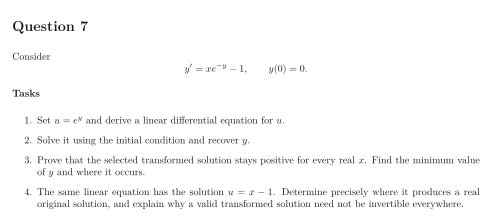
Step 2: Establish the inverse domain and minimum. Let . Then and . Its unique global minimum occurs at and equals . Therefore the logarithm is defined and smooth for all real , so the IVP interval is .
Since the logarithm is increasing, the solution has unique minimum Verification is immediate from : , and .
Step 3: Test another transformed solution. The linear solution is defined everywhere, but only for . It gives On that interval, , verifying the original equation. At , , and for no real logarithm of exists. The map has range ; solving the transformed linear equation does not remove that range restriction.
See the diagram in the original worksheet below.