Question 9
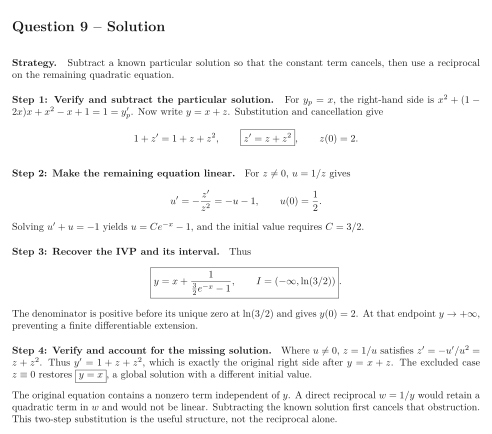
Consider the equation A particular solution is suggested: .
Tasks
Verify the suggested solution and derive the equation for .
On a branch with , set and derive a linear equation for .
Solve the IVP and find its maximal interval containing .
Verify the recovered solution through the substitutions, restore the solution excluded by , and explain why this reciprocal is applied to the difference from rather than directly to .
Show solutionHide solution
Question 9 – Solution
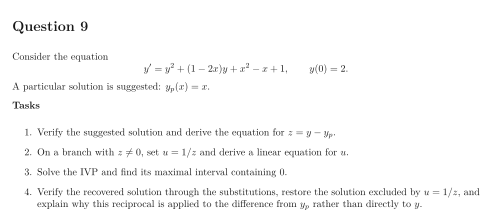
Strategy. Subtract a known particular solution so that the constant term cancels, then use a reciprocal on the remaining quadratic equation.
Step 1: Verify and subtract the particular solution. For , the right-hand side is . Now write . Substitution and cancellation give
Step 2: Make the remaining equation linear. For , gives Solving yields , and the initial value requires .
Step 3: Recover the IVP and its interval. Thus The denominator is positive before its unique zero at and gives . At that endpoint , preventing a finite differentiable extension.
Step 4: Verify and account for the missing solution. Where , satisfies . Thus , which is exactly the original right side after . The excluded case restores , a global solution with a different initial value.
The original equation contains a nonzero term independent of . A direct reciprocal would retain a quadratic term in and would not be linear. Subtracting the known solution first cancels that obstruction. This two-step substitution is the useful structure, not the reciprocal alone.