Question 5
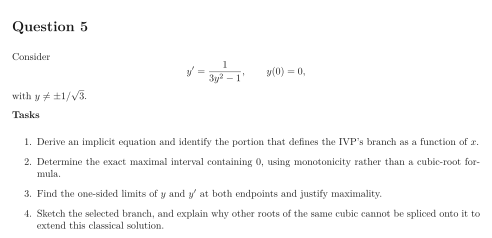
Consider with .
Tasks
Derive an implicit equation and identify the portion that defines the IVP’s branch as a function of .
Determine the exact maximal interval containing , using monotonicity rather than a cubic-root formula.
Find the one-sided limits of and at both endpoints and justify maximality.
Sketch the selected branch, and explain why other roots of the same cubic cannot be spliced onto it to extend this classical solution.
Show solutionHide solution
Question 5 – Solution
Strategy. Regard as a function of . Its turning points identify where the selected inverse branch stops being a regular graph.
Step 1: Integrate without solving the cubic. The chain rule gives The initial value sets the integration constant to zero. Put . On , , so is strictly decreasing and has a differentiable inverse there.
Step 2: Map the branch endpoints. Let . Then and . Hence the inverse through exists exactly on Differentiating its defining relation recovers and verifies the original equation on this branch.
Step 3: Analyze the folds. As , ; as , . In both cases , so . Both finite limiting values are excluded by the original equation.
See the diagram in the original worksheet below.
Step 4: Reject a change of root. The dashed pieces show other parts of the algebraic curve. A continuous switch at a fold must include an excluded value of with unbounded slope; a switch to a different root at that would be discontinuous. Neither gives a classical extension. The cubic relation alone does not specify the IVP’s interval or branch.
