Question 7
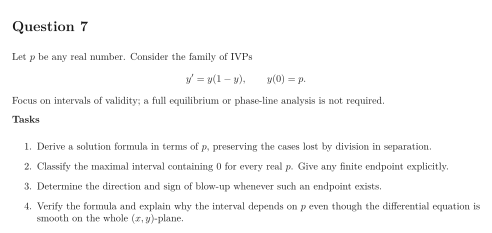
Let be any real number. Consider the family of IVPs Focus on intervals of validity; a full equilibrium or phase-line analysis is not required.
Tasks
Derive a solution formula in terms of , preserving the cases lost by division in separation.
Classify the maximal interval containing for every real . Give any finite endpoint explicitly.
Determine the direction and sign of blow-up whenever such an endpoint exists.
Verify the formula and explain why the interval depends on even though the differential equation is smooth on the whole -plane.
Show solutionHide solution
Question 7 – Solution
Strategy. A denominator zero is relevant only in the connected component containing the initial point. Preserve constant solutions before separating.
Step 1: Obtain a parameter formula. The constant solutions are . Otherwise separation gives . Applying the initial value yields a formula that also includes both constants: Its denominator satisfies . A zero requires , which occurs exactly when or .
Step 2: Select the component containing zero. When it exists, set . The complete classification is For , both terms of are positive. The cases are global constants.
Step 3: Determine the endpoint behavior. If , then as , while , so . If , then as , while , so . Neither pole is removable.
See the diagram in the original worksheet below.
Step 4: Verify and interpret. With , , and Smoothness gives local existence and uniqueness. It does not prevent the finite-time blow-up found for ; the initial value determines whether the selected solution encounters a pole.
