Question 1
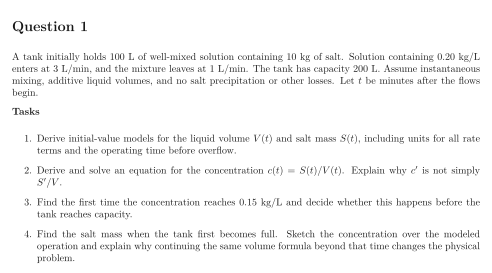
A tank initially holds L of well-mixed solution containing kg of salt. Solution containing kg/L enters at L/min, and the mixture leaves at L/min. The tank has capacity L. Assume instantaneous mixing, additive liquid volumes, and no salt precipitation or other losses. Let be minutes after the flows begin.
Tasks
Derive initial-value models for the liquid volume and salt mass , including units for all rate terms and the operating time before overflow.
Derive and solve an equation for the concentration . Explain why is not simply .
Find the first time the concentration reaches kg/L and decide whether this happens before the tank reaches capacity.
Find the salt mass when the tank first becomes full. Sketch the concentration over the modeled operation and explain why continuing the same volume formula beyond that time changes the physical problem.
Show solutionHide solution
Question 1 – Solution
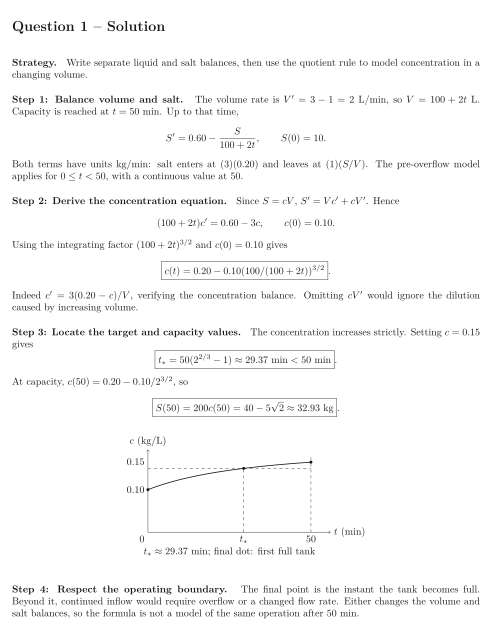
Strategy. Write separate liquid and salt balances, then use the quotient rule to model concentration in a changing volume.
Step 1: Balance volume and salt. The volume rate is L/min, so L. Capacity is reached at min. Up to that time, Both terms have units kg/min: salt enters at and leaves at . The pre-overflow model applies for , with a continuous value at .
Step 2: Derive the concentration equation. Since , . Hence Using the integrating factor and gives Indeed , verifying the concentration balance. Omitting would ignore the dilution caused by increasing volume.
Step 3: Locate the target and capacity values. The concentration increases strictly. Setting gives At capacity, , so
See the diagram in the original worksheet below.
Step 4: Respect the operating boundary. The final point is the instant the tank becomes full. Beyond it, continued inflow would require overflow or a changed flow rate. Either changes the volume and salt balances, so the formula is not a model of the same operation after min.