Question 3
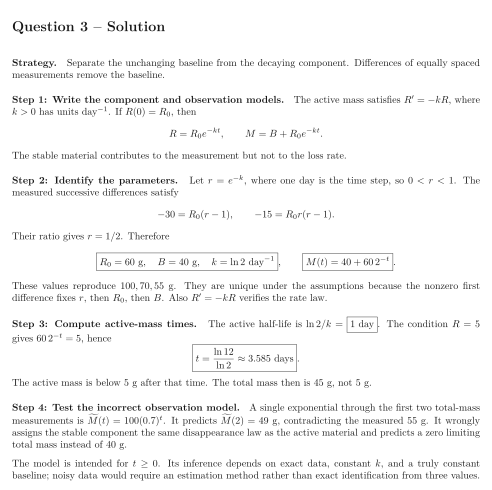
A specimen contains a stable material of unknown mass and an active material of mass that disappears from the measured specimen at a rate proportional to . Assume the stable material is unaffected and all disappearance products leave the measured mass. Thus the measured mass is . Measurements, treated as exact, are where is in days. Assume , , and a positive constant disappearance coefficient.
Tasks
Formulate the active-mass IVP and the resulting measurement model.
Determine uniquely the stable mass, initial active mass, and disappearance coefficient from the data.
Find the active material’s half-life and the time at which only g of active material remain.
A technician fits exponential decay directly to the total mass using the first two measurements. Test that model against the third measurement and explain the modeling error.
Show solutionHide solution
Question 3 – Solution
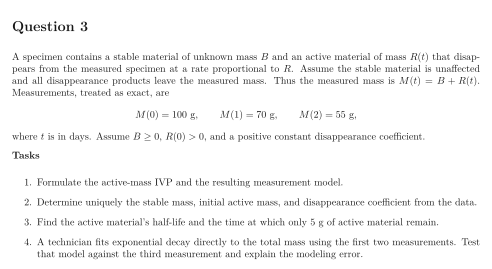
Strategy. Separate the unchanging baseline from the decaying component. Differences of equally spaced measurements remove the baseline.
Step 1: Write the component and observation models. The active mass satisfies , where has units day. If , then The stable material contributes to the measurement but not to the loss rate.
Step 2: Identify the parameters. Let , where one day is the time step, so . The measured successive differences satisfy Their ratio gives . Therefore These values reproduce g. They are unique under the assumptions because the nonzero first difference fixes , then , then . Also verifies the rate law.
Step 3: Compute active-mass times. The active half-life is . The condition gives , hence The active mass is below g after that time. The total mass then is g, not g.
Step 4: Test the incorrect observation model. A single exponential through the first two total-mass measurements is . It predicts g, contradicting the measured g. It wrongly assigns the stable component the same disappearance law as the active material and predicts a zero limiting total mass instead of g.
The model is intended for . Its inference depends on exact data, constant , and a truly constant baseline; noisy data would require an estimation method rather than exact identification from three values.