Question 9
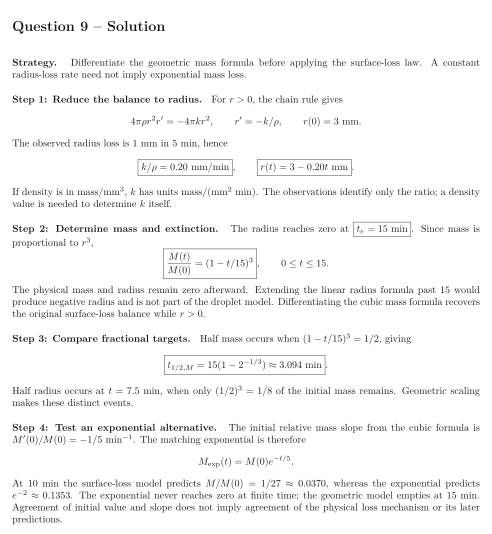
A spherical droplet has constant density and radius . Assume its mass disappears at a rate proportional to its current surface area, with a constant coefficient : while the droplet exists. Radius decreases from mm to mm during the first minutes. Ignore changes in shape, density and environmental conditions.
Tasks
Derive the radius IVP from the mass balance and identify and its units from the observations. Can itself be found without knowing ?
Find the extinction time and the fraction of original mass remaining at any time before extinction.
Determine when half the original mass remains; compare this with the time at which the radius is halved.
Fit an exponential mass-loss model with the same initial mass and initial mass-loss rate. Compare the two predictions at minutes and discuss their extinction predictions.
Show solutionHide solution
Question 9 – Solution
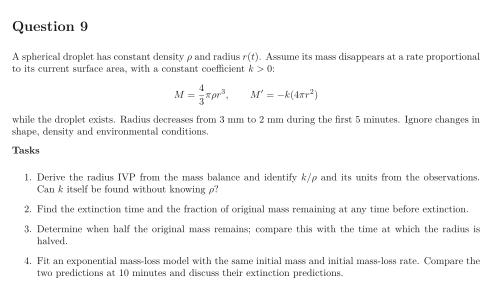
Strategy. Differentiate the geometric mass formula before applying the surface-loss law. A constant radius-loss rate need not imply exponential mass loss.
Step 1: Reduce the balance to radius. For , the chain rule gives The observed radius loss is mm in min, hence If density is in mass/mm, has units mass/(mm min). The observations identify only the ratio; a density value is needed to determine itself.
Step 2: Determine mass and extinction. The radius reaches zero at . Since mass is proportional to , The physical mass and radius remain zero afterward. Extending the linear radius formula past would produce negative radius and is not part of the droplet model. Differentiating the cubic mass formula recovers the original surface-loss balance while .
Step 3: Compare fractional targets. Half mass occurs when , giving Half radius occurs at min, when only of the initial mass remains. Geometric scaling makes these distinct events.
Step 4: Test an exponential alternative. The initial relative mass slope from the cubic formula is min. The matching exponential is therefore At min the surface-loss model predicts , whereas the exponential predicts . The exponential never reaches zero at finite time; the geometric model empties at min. Agreement of initial value and slope does not imply agreement of the physical loss mechanism or its later predictions.