Question 1
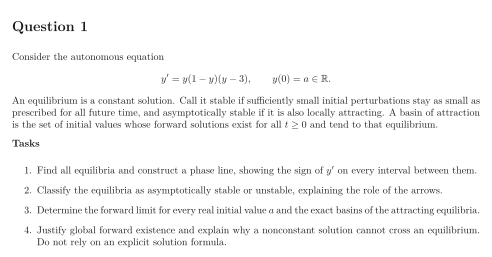
Consider the autonomous equation An equilibrium is a constant solution. Call it stable if sufficiently small initial perturbations stay as small as prescribed for all future time, and asymptotically stable if it is also locally attracting. A basin of attraction is the set of initial values whose forward solutions exist for all and tend to that equilibrium.
Tasks
Find all equilibria and construct a phase line, showing the sign of on every interval between them.
Classify the equilibria as asymptotically stable or unstable, explaining the role of the arrows.
Determine the forward limit for every real initial value and the exact basins of the attracting equilibria.
Justify global forward existence and explain why a nonconstant solution cannot cross an equilibrium. Do not rely on an explicit solution formula.
Show solutionHide solution
Question 1 – Solution
Strategy. Use sign intervals and uniqueness to trap solutions; bounded monotone trajectories reveal their limits.
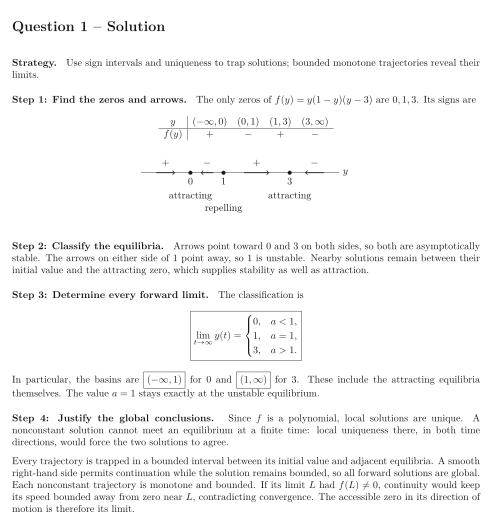
Step 1: Find the zeros and arrows. The only zeros of are . Its signs are
See the diagram in the original worksheet below.
Step 2: Classify the equilibria. Arrows point toward and on both sides, so both are asymptotically stable. The arrows on either side of point away, so is unstable. Nearby solutions remain between their initial value and the attracting zero, which supplies stability as well as attraction.
Step 3: Determine every forward limit. The classification is In particular, the basins are for and for . These include the attracting equilibria themselves. The value stays exactly at the unstable equilibrium.
Step 4: Justify the global conclusions. Since is a polynomial, local solutions are unique. A nonconstant solution cannot meet an equilibrium at a finite time: local uniqueness there, in both time directions, would force the two solutions to agree.
Every trajectory is trapped in a bounded interval between its initial value and adjacent equilibria. A smooth right-hand side permits continuation while the solution remains bounded, so all forward solutions are global. Each nonconstant trajectory is monotone and bounded. If its limit had , continuity would keep its speed bounded away from zero near , contradicting convergence. The accessible zero in its direction of motion is therefore its limit.