Question 4
Construct a real polynomial autonomous equation with exactly the equilibria and these properties:
is asymptotically stable;
attracts from above and repels from below;
is unstable;
.
Tasks
Determine the smallest possible degree, using the sign changes required at the three zeros.
Construct the polynomial of that degree and prove uniqueness among polynomials of that degree satisfying all the requirements.
Draw its phase line and verify each requested stability property.
Find the forward limits for and . Explain why knowing the equilibrium locations alone would not determine these limits.
Show solutionHide solution
Question 4 – Solution
Strategy. Translate attraction and repulsion into signs, then into the parity of each root’s multiplicity.
Step 1: Establish the minimum degree. At a two-sided attracting or repelling equilibrium, the sign must reverse, requiring an odd root multiplicity. At the specified semistable zero, the sign must be negative on both sides, requiring even multiplicity. The smallest multiplicities at are therefore , so the degree is at least .
Step 2: Determine the coefficient. Every degree-four candidate must have the form At this gives . The prescribed rate forces , hence This has exactly the three requested real zeros. The forced multiplicities exhaust degree four, and the rate condition fixes the only remaining coefficient, proving uniqueness at the minimum degree.
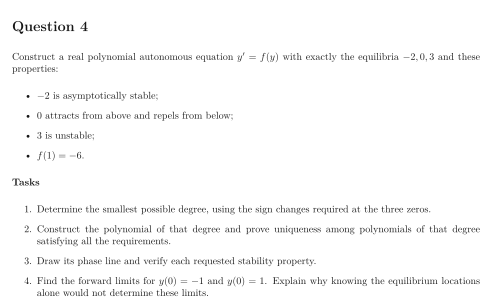
Step 3: Verify the phase line. The signs are on the four successive intervals cut by .
See the diagram in the original worksheet below.
Thus arrows approach from both sides; near they point left on both sides, attracting from above and repelling from below; and they point away from on both sides. These are precisely the requested behaviors.
Step 4: Infer the selected limits. Starting at , the solution decreases within and tends to . Starting at , it decreases within and tends to . Smoothness and bounded trapping ensure global forward existence for both, and uniqueness prevents crossing the bounding equilibria.
Equilibrium locations only identify zeros. Changing root multiplicities or the overall sign can change the arrows and therefore the limiting behavior, even when the zero set is unchanged. The stability and rate requirements supply information that the locations alone do not.