Question 6
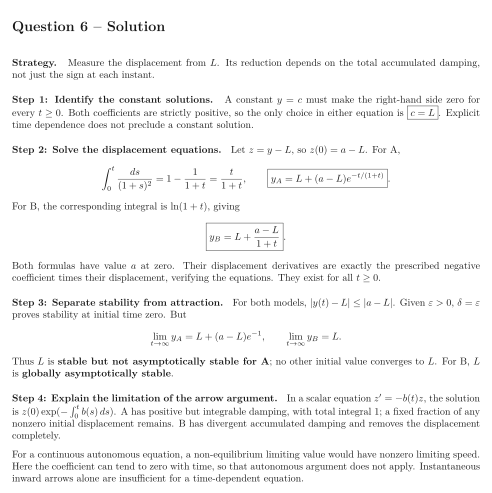
For a fixed real constant , compare the two equations on : Their right-hand sides depend on time. Nevertheless, at every finite time each points toward whenever . Use stability relative to the initial time .
Tasks
Find every constant solution of each equation and explain why these are equilibria despite the explicit time dependence.
Solve both IVPs with and verify the initial values and differential equations.
Decide whether is stable and whether it is asymptotically stable for each equation. Prove the claims directly from the solutions.
Explain why arrows pointing toward at every finite time do not guarantee attraction in both models. Relate the distinction to the accumulated coefficient integral.
Show solutionHide solution
Question 6 – Solution
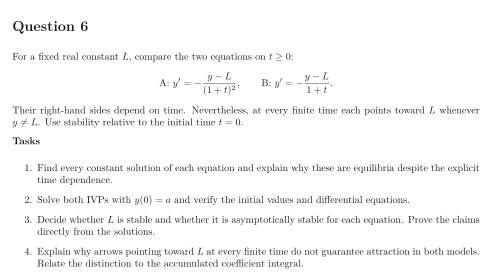
Strategy. Measure the displacement from . Its reduction depends on the total accumulated damping, not just the sign at each instant.
Step 1: Identify the constant solutions. A constant must make the right-hand side zero for every . Both coefficients are strictly positive, so the only choice in either equation is . Explicit time dependence does not preclude a constant solution.
Step 2: Solve the displacement equations. Let , so . For A, For B, the corresponding integral is , giving Both formulas have value at zero. Their displacement derivatives are exactly the prescribed negative coefficient times their displacement, verifying the equations. They exist for all .
Step 3: Separate stability from attraction. For both models, . Given , proves stability at initial time zero. But Thus is stable but not asymptotically stable for A; no other initial value converges to . For B, is globally asymptotically stable.
Step 4: Explain the limitation of the arrow argument. In a scalar equation , the solution is . A has positive but integrable damping, with total integral ; a fixed fraction of any nonzero initial displacement remains. B has divergent accumulated damping and removes the displacement completely.
For a continuous autonomous equation, a non-equilibrium limiting value would have nonzero limiting speed. Here the coefficient can tend to zero with time, so that autonomous argument does not apply. Instantaneous inward arrows alone are insufficient for a time-dependent equation.