Question 10
Use explicit Euler to integrate from backward to . Begin with the benchmark terminal value and use time increments . This is the explicit Euler formula on a decreasing time grid, not the implicit method sometimes called backward Euler.
Tasks
Derive the update on the decreasing grid and compute the approximation at .
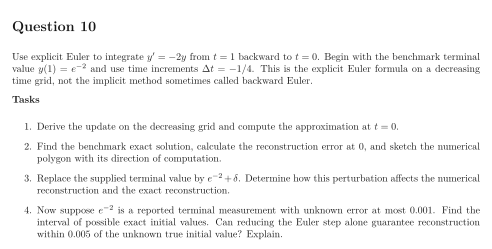
Find the benchmark exact solution, calculate the reconstruction error at , and sketch the numerical polygon with its direction of computation.
Replace the supplied terminal value by . Determine how this perturbation affects the numerical reconstruction and the exact reconstruction.
Now suppose is a reported terminal measurement with unknown error at most . Find the interval of possible exact initial values. Can reducing the Euler step alone guarantee reconstruction within of the unknown true initial value? Explain.
Show solutionHide solution
Question 10 – Solution
Strategy. Track the sign of the time increment and distinguish discretization error from amplification of uncertain terminal data.
Step 1: March backward explicitly. Writing , Euler gives After four steps,
Step 2: Compare with the exact benchmark. The exact solution is , giving . Thus the numerical reconstruction error is
See the diagram in the original worksheet below.
Each decreasing-time step amplifies the current value by . The exact amplification over a quarter-unit backward step is , explaining the numerical underestimate.
Step 3: Propagate a data perturbation. Linearity shows that replacing the terminal value by changes the numerical reconstruction by whereas exact backward evolution changes it by . With backward steps of size magnitude , the numerical amplification is , which tends to , not to zero. Refinement improves the evolution calculation but does not eliminate sensitivity to data.
Step 4: Separate the uncertainty floor. The possible exact initial values form Its half-width is about , exceeding . No single reconstruction from the reported value can be within of every possible true initial value in that interval. Reducing the step alone therefore cannot supply the requested guarantee; the terminal data would also need tighter uncertainty. Forward physical decay and backward data amplification describe different directions of evolution.