Question 2
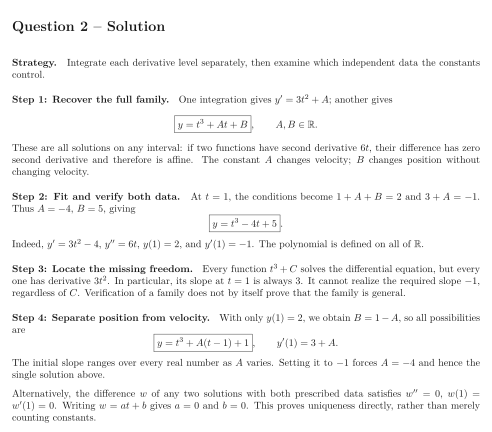
An unknown trajectory satisfies A student writes as the general solution because differentiating twice gives .
Tasks
Find every solution of the differential equation by integrating twice. Explain the role of each integration constant.
Apply both initial conditions and verify the resulting solution in the equation and the data.
Diagnose the student’s proposed general solution. Which initial slopes at can that smaller family realize?
Retain only . Describe all resulting solutions and their slopes at . Prove directly that restoring the slope condition selects exactly one solution.
Show solutionHide solution
Question 2 – Solution
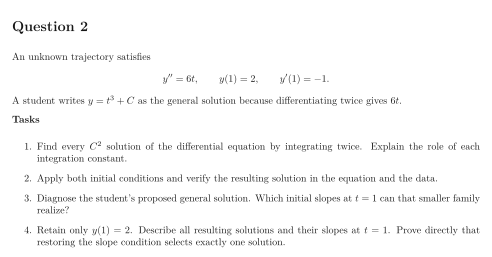
Strategy. Integrate each derivative level separately, then examine which independent data the constants control.
Step 1: Recover the full family. One integration gives ; another gives These are all solutions on any interval: if two functions have second derivative , their difference has zero second derivative and therefore is affine. The constant changes velocity; changes position without changing velocity.
Step 2: Fit and verify both data. At , the conditions become and . Thus , , giving Indeed, , , , and . The polynomial is defined on all of .
Step 3: Locate the missing freedom. Every function solves the differential equation, but every one has derivative . In particular, its slope at is always 3. It cannot realize the required slope , regardless of . Verification of a family does not by itself prove that the family is general.
Step 4: Separate position from velocity. With only , we obtain , so all possibilities are The initial slope ranges over every real number as varies. Setting it to forces and hence the single solution above.
Alternatively, the difference of any two solutions with both prescribed data satisfies , . Writing gives and . This proves uniqueness directly, rather than merely counting constants.