Question 10
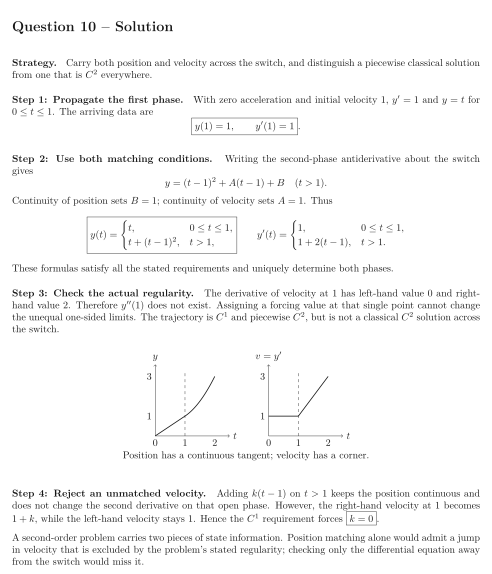
A prescribed acceleration changes abruptly at : Seek a function that is on and on each open side of 1, satisfying the equation there. No value for at 1 is assumed. Thus position and velocity must be continuous at the switch.
Tasks
Integrate on the first phase and find the position and velocity arriving at .
Integrate on the second phase with two new constants, determine them using the matching conditions, and give the complete piecewise trajectory.
Compute the one-sided derivatives of velocity at the switch. Can any assigned value of the forcing at make this trajectory a classical solution through the switch?
Sketch position and velocity. A student adds to the second-phase position while leaving the first phase unchanged. Determine which satisfy the stated requirements, and explain why position matching alone is insufficient.
Show solutionHide solution
Question 10 – Solution
Strategy. Carry both position and velocity across the switch, and distinguish a piecewise classical solution from one that is everywhere.
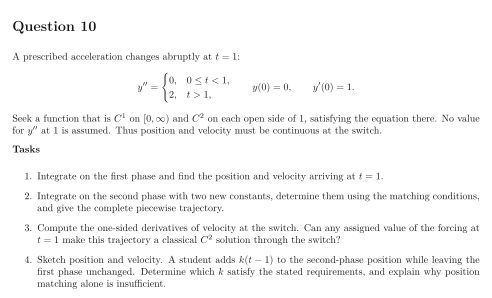
Step 1: Propagate the first phase. With zero acceleration and initial velocity 1, and for . The arriving data are
Step 2: Use both matching conditions. Writing the second-phase antiderivative about the switch gives Continuity of position sets ; continuity of velocity sets . Thus These formulas satisfy all the stated requirements and uniquely determine both phases.
Step 3: Check the actual regularity. The derivative of velocity at 1 has left-hand value 0 and right-hand value 2. Therefore does not exist. Assigning a forcing value at that single point cannot change the unequal one-sided limits. The trajectory is and piecewise , but is not a classical solution across the switch.
See the diagram in the original worksheet below.
Step 4: Reject an unmatched velocity. Adding on keeps the position continuous and does not change the second derivative on that open phase. However, the right-hand velocity at 1 becomes , while the left-hand velocity stays 1. Hence the requirement forces .
A second-order problem carries two pieces of state information. Position matching alone would admit a jump in velocity that is excluded by the problem’s stated regularity; checking only the differential equation away from the switch would miss it.