Question 4
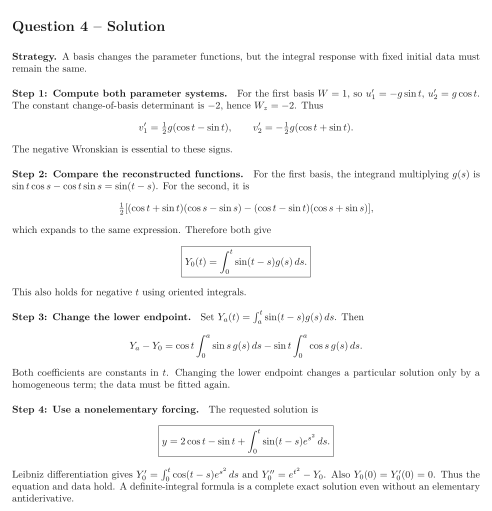
Let be continuous on . For , compare the homogeneous bases In both parameter constructions, set the two parameter values to zero at .
Tasks
Derive the parameter derivatives for both bases, including the sign of each Wronskian.
Prove directly that both constructions give the same integral formula for the zero-data response.
If the lower endpoint is changed from zero to , express the difference between the two particular solutions as a homogeneous combination.
Apply the formula to with , . Verify the solution without assuming that its integrals have elementary antiderivatives.
Show solutionHide solution
Question 4 – Solution
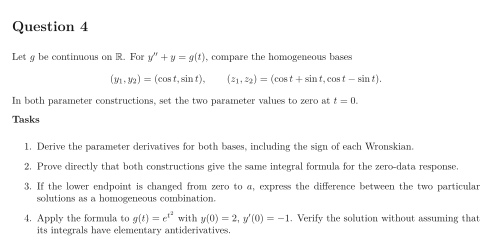
Strategy. A basis changes the parameter functions, but the integral response with fixed initial data must remain the same.
Step 1: Compute both parameter systems. For the first basis , so , . The constant change-of-basis determinant is , hence . Thus The negative Wronskian is essential to these signs.
Step 2: Compare the reconstructed functions. For the first basis, the integrand multiplying is . For the second, it is which expands to the same expression. Therefore both give This also holds for negative using oriented integrals.
Step 3: Change the lower endpoint. Set . Then Both coefficients are constants in . Changing the lower endpoint changes a particular solution only by a homogeneous term; the data must be fitted again.
Step 4: Use a nonelementary forcing. The requested solution is Leibniz differentiation gives and . Also . Thus the equation and data hold. A definite-integral formula is a complete exact solution even without an elementary antiderivative.