Question 8
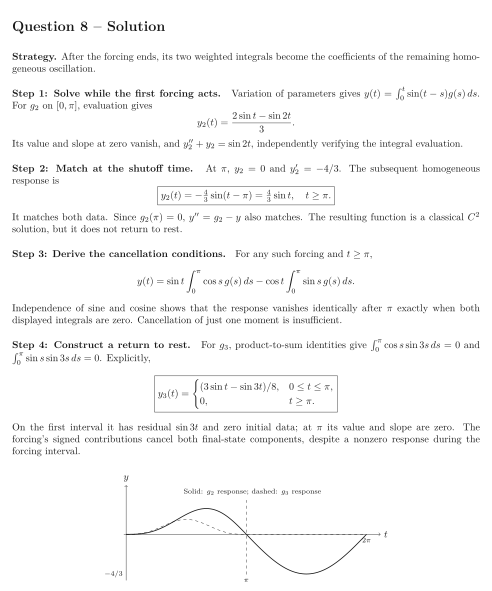
For , solve with zero initial value and slope. First use the continuous finite-duration forcing Later compare it with , defined in the same way using .
Tasks
Derive the integral response and solve explicitly for on .
Find the response after , checking the matching value and slope. Does turning off the forcing return the solution to rest?
For any continuous forcing supported in , derive the two integral conditions equivalent to for every .
Test against these conditions and find its response. Explain how a nonzero forcing can leave no later motion.
Show solutionHide solution
Question 8 – Solution
Strategy. After the forcing ends, its two weighted integrals become the coefficients of the remaining homogeneous oscillation.
Step 1: Solve while the first forcing acts. Variation of parameters gives . For on , evaluation gives Its value and slope at zero vanish, and , independently verifying the integral evaluation.
Step 2: Match at the shutoff time. At , and . The subsequent homogeneous response is It matches both data. Since , also matches. The resulting function is a classical solution, but it does not return to rest.
Step 3: Derive the cancellation conditions. For any such forcing and , Independence of sine and cosine shows that the response vanishes identically after exactly when both displayed integrals are zero. Cancellation of just one moment is insufficient.
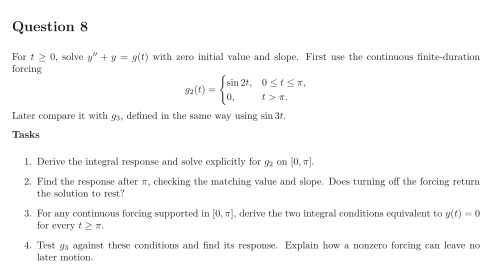
Step 4: Construct a return to rest. For , product-to-sum identities give and . Explicitly, On the first interval it has residual and zero initial data; at its value and slope are zero. The forcing’s signed contributions cancel both final-state components, despite a nonzero response during the forcing interval.
See the diagram in the original worksheet below.