Question 10
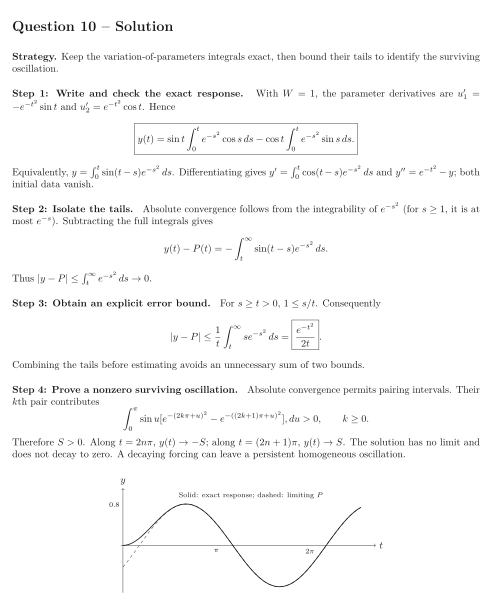
For , solve Define the convergent integrals and . No special-function evaluations of or are required.
Tasks
Use variation of parameters to express the exact solution through two finite definite integrals, and verify its initial data and residual.
Show that the solution approaches the periodic function in the sense that .
Prove the quantitative estimate for every .
Prove by pairing successive positive and negative half-waves of sine. Use this to show that does not tend to zero, even though the forcing does.
Show solutionHide solution
Question 10 – Solution
Strategy. Keep the variation-of-parameters integrals exact, then bound their tails to identify the surviving oscillation.
Step 1: Write and check the exact response. With , the parameter derivatives are and . Hence Equivalently, . Differentiating gives and ; both initial data vanish.
Step 2: Isolate the tails. Absolute convergence follows from the integrability of (for , it is at most ). Subtracting the full integrals gives Thus .
Step 3: Obtain an explicit error bound. For , . Consequently Combining the tails before estimating avoids an unnecessary sum of two bounds.
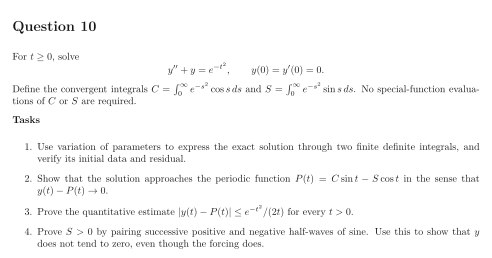
Step 4: Prove a nonzero surviving oscillation. Absolute convergence permits pairing intervals. Their th pair contributes Therefore . Along , ; along , . The solution has no limit and does not decay to zero. A decaying forcing can leave a persistent homogeneous oscillation.
See the diagram in the original worksheet below.