Question 4
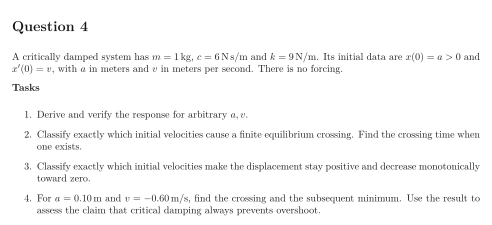
A critically damped system has , and . Its initial data are and , with in meters and in meters per second. There is no forcing.
Tasks
Derive and verify the response for arbitrary .
Classify exactly which initial velocities cause a finite equilibrium crossing. Find the crossing time when one exists.
Classify exactly which initial velocities make the displacement stay positive and decrease monotonically toward zero.
For and , find the crossing and the subsequent minimum. Use the result to assess the claim that critical damping always prevents overshoot.
Show solutionHide solution
Question 4 – Solution
Strategy. Critical damping fixes the repeated root, but the sign of the linear factor still depends on the initial velocity.
Step 1: Fit the repeated-root solution. The characteristic polynomial is . Thus Here the numerical rate has units . The two data follow immediately, and substitution gives .
Step 2: Classify crossings. Since , a positive-time zero occurs exactly when . In that case it is unique and The linear factor changes sign there, so this is a crossing, not a touch. If , the factor remains positive for all finite , including the equality case .
Step 3: Classify monotone positive return. For , the displacement is positive. Its derivative is nonpositive for all exactly when , because then begins nonpositive and decreases. Thus the required range is For , the mass first moves farther from equilibrium. For , it crosses equilibrium and cannot be a positive monotone return.
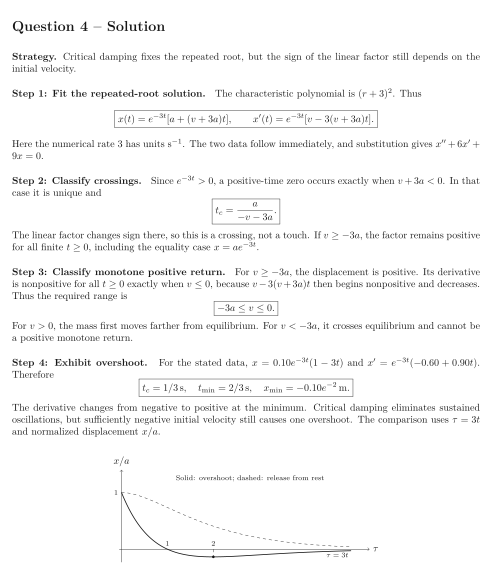
Step 4: Exhibit overshoot. For the stated data, and . Therefore The derivative changes from negative to positive at the minimum. Critical damping eliminates sustained oscillations, but sufficiently negative initial velocity still causes one overshoot. The comparison uses and normalized displacement .
See the diagram in the original worksheet below.