Question 6
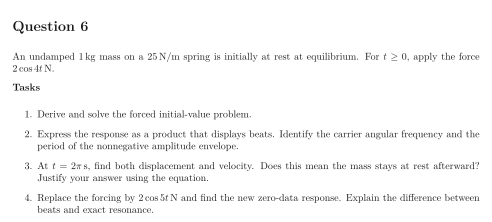
An undamped mass on a spring is initially at rest at equilibrium. For , apply the force .
Tasks
Derive and solve the forced initial-value problem.
Express the response as a product that displays beats. Identify the carrier angular frequency and the period of the nonnegative amplitude envelope.
At , find both displacement and velocity. Does this mean the mass stays at rest afterward? Justify your answer using the equation.
Replace the forcing by and find the new zero-data response. Explain the difference between beats and exact resonance.
Show solutionHide solution
Question 6 – Solution
Strategy. The homogeneous correction needed to fit rest data creates the nearby-frequency interference; exact resonance requires a different particular form.
Step 1: Solve the nonresonant problem. Newton’s law gives , . Since , a particular response is . Fitting zero data gives Its second derivative plus equals , and both initial data vanish.
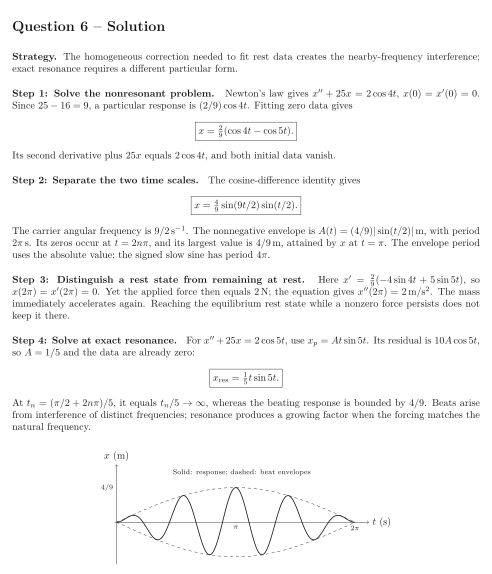
Step 2: Separate the two time scales. The cosine-difference identity gives The carrier angular frequency is . The nonnegative envelope is , with period . Its zeros occur at , and its largest value is , attained by at . The envelope period uses the absolute value; the signed slow sine has period .
Step 3: Distinguish a rest state from remaining at rest. Here , so . Yet the applied force then equals ; the equation gives . The mass immediately accelerates again. Reaching the equilibrium rest state while a nonzero force persists does not keep it there.
Step 4: Solve at exact resonance. For , use . Its residual is , so and the data are already zero: At , it equals , whereas the beating response is bounded by . Beats arise from interference of distinct frequencies; resonance produces a growing factor when the forcing matches the natural frequency.
See the diagram in the original worksheet below.