Question 8
A mass is connected to a moving support by a spring with and a parallel viscous damper with . Let be support displacement and the mass’s absolute displacement, measured in the same positive direction about equilibrium. Here and . Spring and damping forces depend on relative displacement and relative velocity.
Tasks
Derive the equations for absolute displacement and relative displacement .
Find the steady amplitude ratios and , where and are the amplitudes of and .
Determine exactly when the absolute amplitude is smaller than the support amplitude, including the equality frequency.
Find the low- and high-frequency limits of both ratios. Explain why good isolation of the mass does not imply small relative spring deformation.
Show solutionHide solution
Question 8 – Solution
Strategy. The damper responds to velocity relative to the support. Distinguish motion of the mass from deformation of the suspension.
Step 1: Derive the two models. Newton’s law gives . Therefore The inertial term in the relative equation comes from ; it is not an extra spring force.
Step 2: Compute both amplitude ratios. Let . Matching sine and cosine in the relative equation gives Thus . Since , its cosine coefficient is , not its amplitude . Simplifying gives The homogeneous roots ensure the initial-data transients decay.
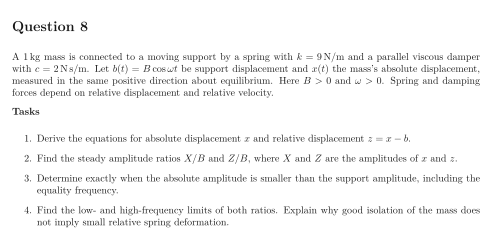
Step 3: Find the isolation threshold. Since , exactly when For , this means . Equality holds at ; below that positive frequency the absolute motion is amplified.
Step 4: Interpret the limiting motions. As , and : the mass follows the slowly moving support. As , but . In fact and , so while . An almost stationary mass can still have relative deformation comparable to the base motion.
See the diagram in the original worksheet below.