Question 1
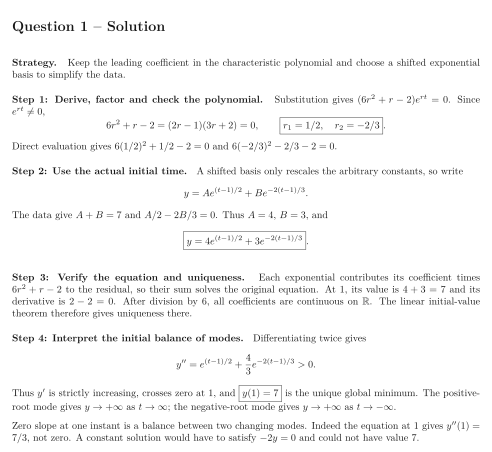
Consider For a constant-coefficient homogeneous second-order equation with distinct real characteristic roots , the general solution is .
Tasks
Substitute to derive the characteristic equation. Find and verify both roots.
Write the general solution using exponentials based at , then determine its constants from the initial data.
Verify the resulting function in the original equation and both initial conditions. Explain why it is the unique solution on .
Classify the stationary point at and determine the limits as and . Explain why zero initial slope does not mean a constant solution.
Show solutionHide solution
Question 1 – Solution
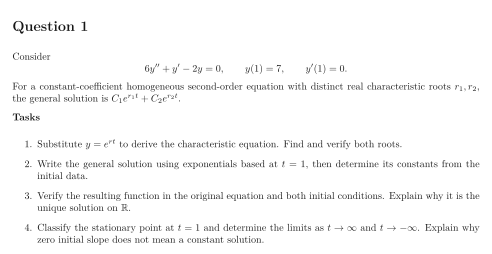
Strategy. Keep the leading coefficient in the characteristic polynomial and choose a shifted exponential basis to simplify the data.
Step 1: Derive, factor and check the polynomial. Substitution gives . Since , Direct evaluation gives and .
Step 2: Use the actual initial time. A shifted basis only rescales the arbitrary constants, so write The data give and . Thus , , and
Step 3: Verify the equation and uniqueness. Each exponential contributes its coefficient times to the residual, so their sum solves the original equation. At 1, its value is and its derivative is . After division by 6, all coefficients are continuous on . The linear initial-value theorem therefore gives uniqueness there.
Step 4: Interpret the initial balance of modes. Differentiating twice gives Thus is strictly increasing, crosses zero at 1, and is the unique global minimum. The positive-root mode gives as ; the negative-root mode gives as .
Zero slope at one instant is a balance between two changing modes. Indeed the equation at 1 gives , not zero. A constant solution would have to satisfy and could not have value 7.