Question 4
For the equation classify the entire range of real initial slopes on the time interval .
Tasks
Find the solution in terms of .
Determine exactly when for every . Prove both necessity and sufficiency.
Determine exactly when the solution is both nonnegative and nonincreasing on , including boundary slopes.
For the remaining slopes, find the unique zero when one occurs, or the unique positive-time maximum when one occurs. Summarize the cases on a diagram of the ratio .
Show solutionHide solution
Question 4 – Solution
Strategy. Factor out a positive exponential and reduce sign questions to affine expressions in .
Step 1: Fit the real-root solution. The roots are . Solving , gives Write , , so .
Step 2: Classify nonnegativity. Since , its sign is the sign of an affine function with values at and at . If , it is positive for all . If , it is negative for sufficiently small positive . Therefore At , the solution is the strictly positive at every finite time.
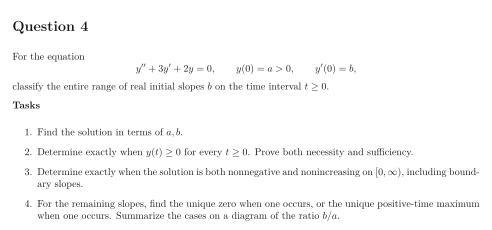
Step 3: Impose monotonicity as well. We have . Its bracket has endpoint values and . Thus it is nonnegative on exactly when and . Combining the conditions yields At , the derivative vanishes initially but is negative for every . Both boundary slopes are included.
See the diagram in the original worksheet below.
Step 4: Resolve the two remaining regimes. If , solving gives the unique zero Both numerator and denominator are negative, and their ratio exceeds 1. The solution crosses from positive to negative and tends to zero from below.
If , it remains positive but initially rises. Solving gives the unique positive-time maximum at The derivative changes from positive to negative there. These cases exhaust all real ; every solution still tends to zero because both roots are negative.