Question 8
The positive response solves a homogeneous second-order equation with real distinct roots. Define its instantaneous decay rate by .
Tasks
Recover the monic differential equation and verify the initial value and slope.
Express as a weighted average of the two decay rates. Find , its limit, and the unique time when .
Differentiate using the differential equation to prove that it is strictly decreasing. Sketch with its limiting level marked.
A constant-rate extrapolation from the initial data predicts . Prove whether this estimate lies above or below the actual response for every , using the curvature of .
Show solutionHide solution
Question 8 – Solution
Strategy. A mixture of two exponential modes need not have a constant effective decay rate; use its logarithmic derivative to quantify the change.
Step 1: Recover and check the equation. The roots are , so the monic characteristic polynomial is . Hence . Direct differentiation gives , so The response is positive because both mode terms are positive.
Step 2: Read the rate as a changing weighted average. Let . Then This averages 1 and 3 with positive weights , so . In particular,
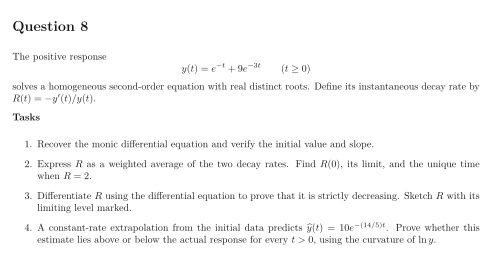
Step 3: Derive the rate equation. Using and , Thus is strictly decreasing; its long-time limit is the slower mode’s rate, rather than an unchanging average of the roots.
See the diagram in the original worksheet below.
Step 4: Compare with a constant-rate prediction. Set . Then and . Since is strictly increasing, integration on for gives Exponentiation preserves this inequality, so for every . The extrapolation matches the initial value and slope but decays too quickly afterward. The changing mode weights, not an error in the initial data, cause the discrepancy.