Question 9
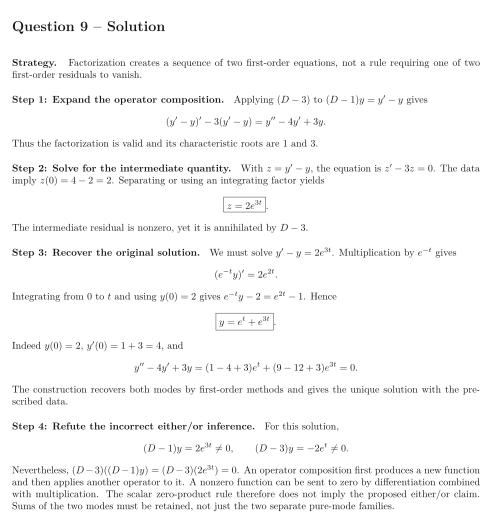
Let denote differentiation with respect to . Consider A student reasons that means every solution must satisfy either or .
Tasks
Verify the operator factorization by expanding it on a twice-differentiable function.
Set . Derive and solve its first-order initial-value problem.
Solve using an integrating factor and the original value . Verify the resulting solution and both initial data.
Test the student’s either/or claim on your solution. Explain why a product of differential operators must not be interpreted as a product of two numbers acting separately on .
Show solutionHide solution
Question 9 – Solution
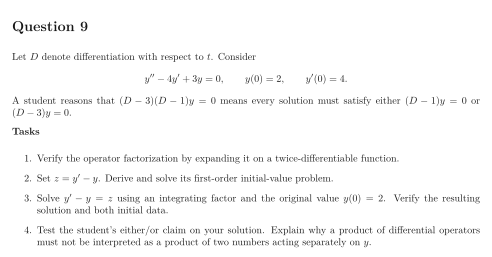
Strategy. Factorization creates a sequence of two first-order equations, not a rule requiring one of two first-order residuals to vanish.
Step 1: Expand the operator composition. Applying to gives Thus the factorization is valid and its characteristic roots are 1 and 3.
Step 2: Solve for the intermediate quantity. With , the equation is . The data imply . Separating or using an integrating factor yields The intermediate residual is nonzero, yet it is annihilated by .
Step 3: Recover the original solution. We must solve . Multiplication by gives Integrating from 0 to and using gives . Hence Indeed , , and The construction recovers both modes by first-order methods and gives the unique solution with the prescribed data.
Step 4: Refute the incorrect either/or inference. For this solution, Nevertheless, . An operator composition first produces a new function and then applies another operator to it. A nonzero function can be sent to zero by differentiation combined with multiplication. The scalar zero-product rule therefore does not imply the proposed either/or claim. Sums of the two modes must be retained, not just the two separate pure-mode families.