Question 10
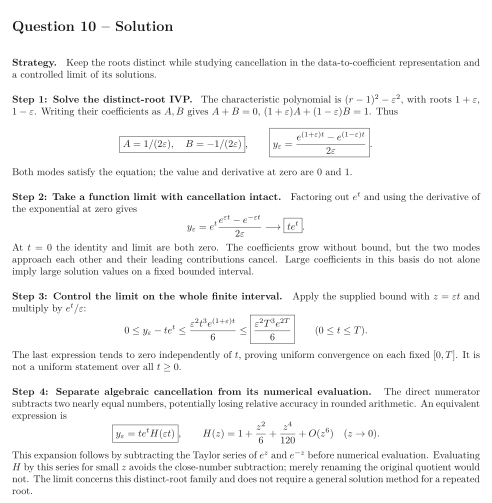
For , consider All parameter values in the problem have real distinct roots. You may use, for , the Taylor bound
Tasks
Find the roots and the exact solution , including both mode coefficients.
For fixed , find the limit of as . Explain how diverging mode coefficients can still produce a finite limit.
Prove an explicit bound on for , where is fixed. Deduce uniform convergence on that interval.
Explain the numerical danger in subtracting the two close exponentials when is small. Derive an equivalent expression using , with , and a small- expansion that avoids that subtraction. Do not solve the limiting differential equation as a separate root case.
Show solutionHide solution
Question 10 – Solution
Strategy. Keep the roots distinct while studying cancellation in the data-to-coefficient representation and a controlled limit of its solutions.
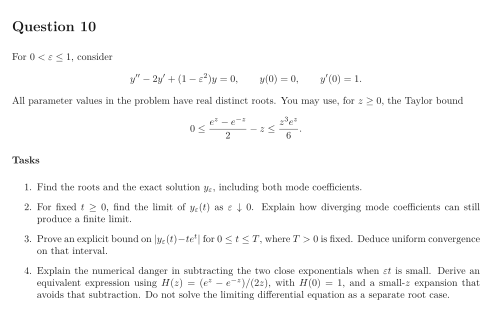
Step 1: Solve the distinct-root IVP. The characteristic polynomial is , with roots , . Writing their coefficients as gives , . Thus Both modes satisfy the equation; the value and derivative at zero are 0 and 1.
Step 2: Take a function limit with cancellation intact. Factoring out and using the derivative of the exponential at zero gives At the identity and limit are both zero. The coefficients grow without bound, but the two modes approach each other and their leading contributions cancel. Large coefficients in this basis do not alone imply large solution values on a fixed bounded interval.
Step 3: Control the limit on the whole finite interval. Apply the supplied bound with and multiply by : The last expression tends to zero independently of , proving uniform convergence on each fixed . It is not a uniform statement over all .
Step 4: Separate algebraic cancellation from its numerical evaluation. The direct numerator subtracts two nearly equal numbers, potentially losing relative accuracy in rounded arithmetic. An equivalent expression is This expansion follows by subtracting the Taylor series of and before numerical evaluation. Evaluating by this series for small avoids the close-number subtraction; merely renaming the original quotient would not. The limit concerns this distinct-root family and does not require a general solution method for a repeated root.