Question 6
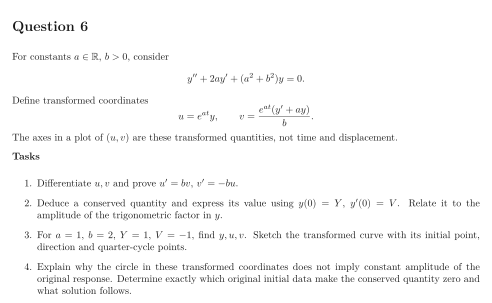
For constants , , consider Define transformed coordinates The axes in a plot of are these transformed quantities, not time and displacement.
Tasks
Differentiate and prove , .
Deduce a conserved quantity and express its value using , . Relate it to the amplitude of the trigonometric factor in .
For , , , , find . Sketch the transformed curve with its initial point, direction and quarter-cycle points.
Explain why the circle in these transformed coordinates does not imply constant amplitude of the original response. Determine exactly which original initial data make the conserved quantity zero and what solution follows.
Show solutionHide solution
Question 6 – Solution
Strategy. Remove the exponential factor and scale the remaining derivative so the two trigonometric coordinates have equal amplitudes.
Step 1: Derive the transformed equations. Directly, . Also, The original equation is essential in the second equality.
Step 2: Identify the invariant and amplitude. Differentiating gives . At zero, The real solution has trigonometric coefficients , , so is exactly its trigonometric amplitude.
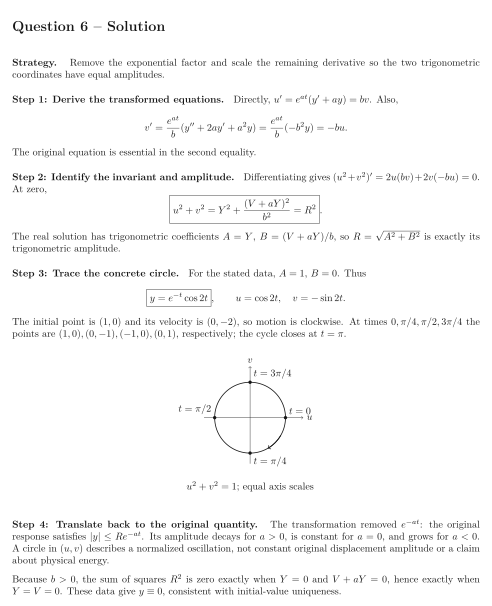
Step 3: Trace the concrete circle. For the stated data, , . Thus The initial point is and its velocity is , so motion is clockwise. At times the points are , respectively; the cycle closes at .
See the diagram in the original worksheet below.
Step 4: Translate back to the original quantity. The transformation removed : the original response satisfies . Its amplitude decays for , is constant for , and grows for . A circle in describes a normalized oscillation, not constant original displacement amplitude or a claim about physical energy.
Because , the sum of squares is zero exactly when and , hence exactly when . These data give , consistent with initial-value uniqueness.