Question 2
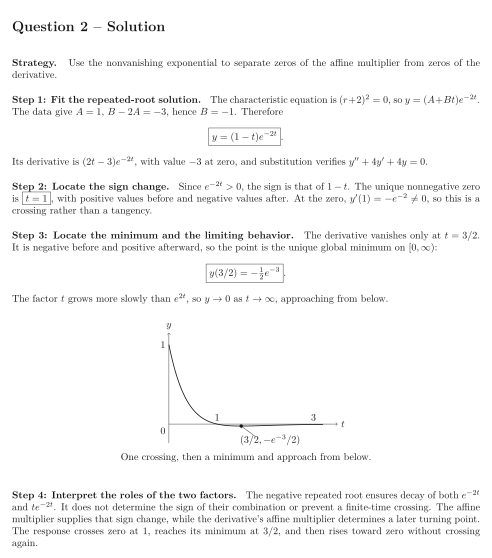
Consider All qualitative conclusions below concern .
Tasks
Solve the IVP using the repeated-root family and verify both data.
Find every nonnegative zero and determine the sign on either side. Does a repeated negative root prevent the response from changing sign?
Find every positive-time stationary point, classify it and calculate its value. Determine the limit and the side from which it is approached.
Sketch the response, marking the zero and minimum. Explain why the extra polynomial factor can change the shape without defeating eventual exponential decay.
Show solutionHide solution
Question 2 – Solution
Strategy. Use the nonvanishing exponential to separate zeros of the affine multiplier from zeros of the derivative.
Step 1: Fit the repeated-root solution. The characteristic equation is , so . The data give , , hence . Therefore Its derivative is , with value at zero, and substitution verifies .
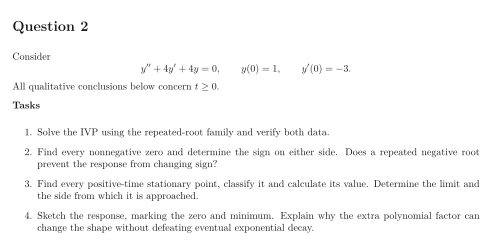
Step 2: Locate the sign change. Since , the sign is that of . The unique nonnegative zero is , with positive values before and negative values after. At the zero, , so this is a crossing rather than a tangency.
Step 3: Locate the minimum and the limiting behavior. The derivative vanishes only at . It is negative before and positive afterward, so the point is the unique global minimum on : The factor grows more slowly than , so as , approaching from below.
See the diagram in the original worksheet below.
Step 4: Interpret the roles of the two factors. The negative repeated root ensures decay of both and . It does not determine the sign of their combination or prevent a finite-time crossing. The affine multiplier supplies that sign change, while the derivative’s affine multiplier determines a later turning point. The response crosses zero at 1, reaches its minimum at , and then rises toward zero without crossing again.