Question 4
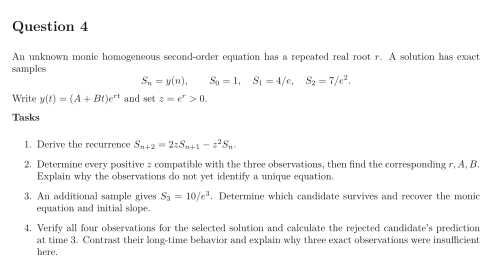
An unknown monic homogeneous second-order equation has a repeated real root . A solution has exact samples Write and set .
Tasks
Derive the recurrence .
Determine every positive compatible with the three observations, then find the corresponding . Explain why the observations do not yet identify a unique equation.
An additional sample gives . Determine which candidate survives and recover the monic equation and initial slope.
Verify all four observations for the selected solution and calculate the rejected candidate’s prediction at time 3. Contrast their long-time behavior and explain why three exact observations were insufficient here.
Show solutionHide solution
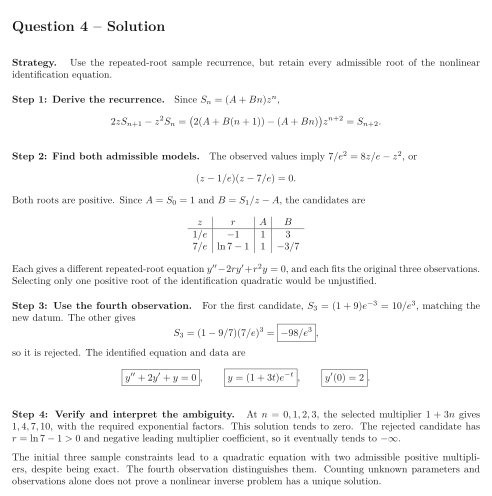
Question 4 – Solution
Strategy. Use the repeated-root sample recurrence, but retain every admissible root of the nonlinear identification equation.
Step 1: Derive the recurrence. Since ,
Step 2: Find both admissible models. The observed values imply , or Both roots are positive. Since and , the candidates are Each gives a different repeated-root equation , and each fits the original three observations. Selecting only one positive root of the identification quadratic would be unjustified.
Step 3: Use the fourth observation. For the first candidate, , matching the new datum. The other gives so it is rejected. The identified equation and data are
Step 4: Verify and interpret the ambiguity. At , the selected multiplier gives , with the required exponential factors. This solution tends to zero. The rejected candidate has and negative leading multiplier coefficient, so it eventually tends to .
The initial three sample constraints lead to a quadratic equation with two admissible positive multipliers, despite being exact. The fourth observation distinguishes them. Counting unknown parameters and observations alone does not prove a nonlinear inverse problem has a unique solution.